|
Author(s): Bertrand Wong
title: Open mathematical problems Publisher: DeGruyter-Brill Year: 2026 ISBN: 9783112236178 (pbk; 9783112236185 (ebk) Price (tentative): € 69.95 (pbk); € 69.95 (ebk) (net) URL: www.degruyterbrill.com/document/doi/10.1515/9783112236185/html Short description: After an almost philosophical discussion of the importance of logic, Wong formulates some possibilities to verify whether some of the famous open problems in mathematics make sense. The problems are: The Navier-Stokes equation, the Riemann hypothesis, twin prime conjecture and the Goldbach and Polignac conjectures. MSC main category: 11 MSC category: 11A41 Other MSC categories: 11A99 03Bxx 03-02 |
|
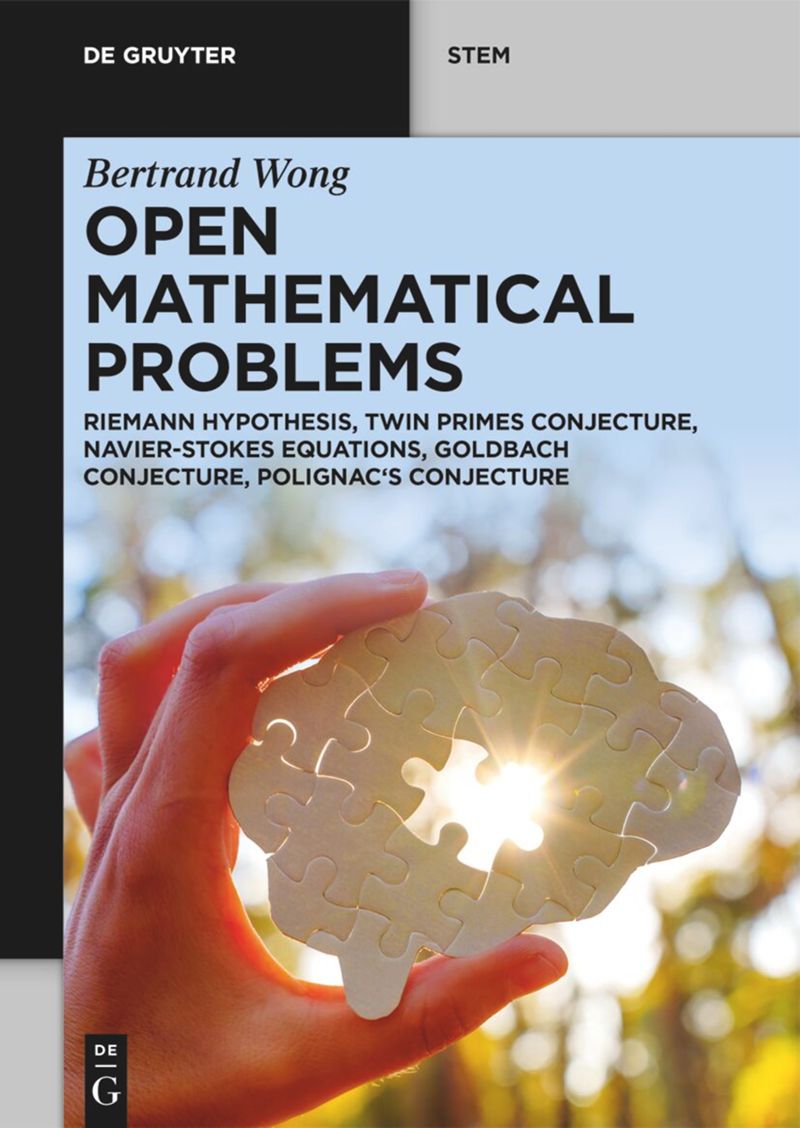
Review: A longer version is available here. From the title of the book, I expected to read about the state of the art about the open problems mentioned in the subtitle (Riemann hypothesis, Twin primes conjecture, Navier-Stokes equation, Goldbach conjecture, and Polignac conjecture), but this is not exactly what the author is aiming at. In the last sentence of his preface, he formulates his intentions: ``It is the aim of this book to stimulate further thought on these important open problems in mathematics as well as the overall-important logic and mathematics itself''. After reading the book, my interpretation is that Wong wants to bring some broad, sometimes almost philosophical thoughts about the importance of mathematics (in particular, the role of logic) in pure and applied science and more broadly in society. Rather than actual attempts to solve the open problems, the author addresses the non-specialist with some general ideas and computer simulations that naturally come to mind when thinking about these problems.
The first quarter of the book (40 pages) contains some philosophical essays explaining these ideas. It illustrates how science and society can only function if there are some premises (axioms) and rules so that decisions are made based on logic deductions. Rules and axioms should be consistent, and conjectures should be (perhaps indirectly) verified by simulations. Logic needs to be verified in its physical consequences. Yet, humans are not entirely logical, since they make illogical decisions based on emotions, or suspicion, or fear. Not everything needs to be binary, sometimes the answer to a yes-or-no question can be undecidable. This is why there are different philosophical schools of mathematical thought, e.g. logicism, intuitionism, or formalism. When we fail to convince each other by logic, there are conflicts and wars.
The rest of the book discusses some ideas for the open problems listed above. Besides explaining the problem, there are diverse thoughts about whether the conjecture or claim is true. In many cases one can verify by a simple check or by using some brute force computer tests that the claim is true under certain conditions. From these, some speculative ideas about the correctness (or not) of the conjecture are derived. There is no exposition of the various serious approaches that have been attempted, which ones are promising, or why they have so far failed. For example, for the Navier-Stokes problem, the author concludes that because of the chaotic behavior of the problem, the claim can only be shown with a certain probability, and for the twin prime conjecture, that computations so far suggest that statistically there is a chance the claim is true, etc.
To conclude, the main objective of Wong's book is not to discuss any of the (sometimes complicated) proofs required in this context, but to convince the reader or the researcher that the conjecture is reasonable, i.e. there is logical support for believing the result. By verifying some numerical computations, the author hopes to increase confidence in the conjecture and perhaps to give insights into possible approaches. I think that for the problems discussed here, there is no need to convince the reader of their correctness, and the provided numerical evidence does not really open any new or promising directions. It is mainly an illustration of how a computer scientist looks at these mathematical problems. Indeed, as he states in an epilogue, for him the meaning of ``rigorous'' (as in rigorous proof) is not even clear.
Unfortunately, there are several typos, and the style is either rather philosophical, matter-of-fact-like, or just an enumeration of technical facts, i.e. not very entertaining for an interested general reader.
The list of 12 references does not include any of the more specialized or popular books that discuss (some of) these open problems. Here are some recommended alternatives: for an introduction, either Ian Stewart, The Great Mathematical Problems (Profile books, 2013) or Tom Wright, Trolling Euclid (CreateSpace Independent Publishing Platform, 2016); John F. Nash Jr. and Michael T. Rassias (ed.), Open Problems in Mathematics (Springer, 2016) is an introduction at a more advanced level. There are several books about the Riemann hypothesis and primes: Barry Mazur and William Stein, Prime Numbers and the Riemann Hypothesis (Cambridge University Press, 2016) requires some mathematical background but is a gentle introduction; Ronald van der Veen and Jan van de Craals, The Riemann Hypothesis. A Million Dollar Problem (MAA Press, 2017) introduces the mathematics with exercises; Paulo Ribenboim, Prime Numbers, Friends Who Give Problems: A Trialogue with Papa Paulo (World Scientific, 2016) is an entertaining Platonic-style discussion. For the twin prime conjecture: Vicky Neale, Closing the Gap (Oxford University Press, 2017).
Reviewer: A. Bultheel (KU Leuven)
© November 11, 2026