|
Author(s): Bertrand Wong
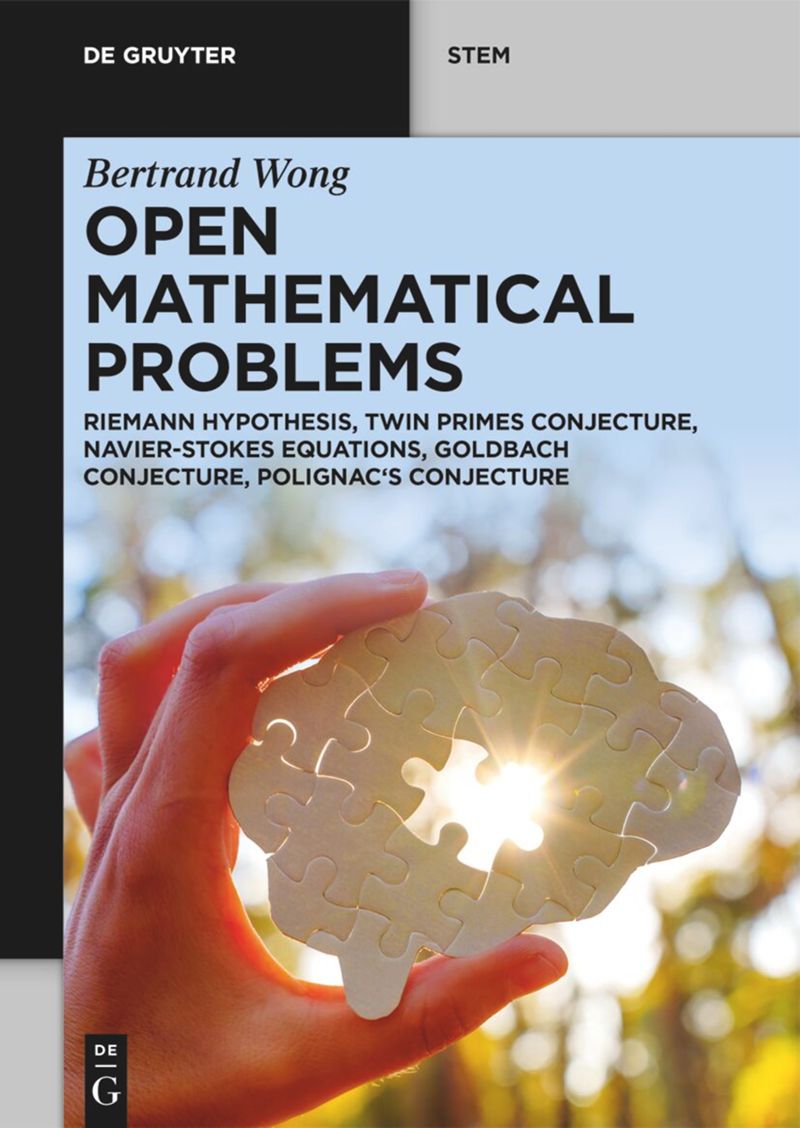
title: Open mathematical problems Publisher: DeGruyter-Brill Year: 2026 ISBN: 9783112236178 (pbk; 9783112236185 (ebk) Price (tentative): € 69.95 (pbk); € 69.95 (ebk) (net) URL: www.degruyterbrill.com/document/doi/10.1515/9783112236185/html Short description: After an almost philosophical discussion of the importance of logic, Wong formulates some possibilities to verify whether some of the famous open problems in mathematics make sense. The problems are: The Navier-Stokes equation, the Riemann hypothesis, twin prime conjecture and the Goldbach and Polignac conjectures. MSC main category: 11 MSC category: 11A41 Other MSC categories: 11A99 03Bxx 03-02 |
|
Review: To be completed
A shorter version is available here or at the MAA website. From the title of the book, I expected to read about the state of the art about the open problems mentioned in the subtitle (Riemann hypothesis, Twin primes conjecture, Navier-Stokes equation, Goldbach conjecture, and Polignac conjecture), but this is not exactly what the author is aiming at. In the last sentence of his preface he formulates his intentions: ``It is the aim of this book to stimulate further thought on these important open problems in mathematics as well as the overall-important logic and mathematics itself''. After reading the book, my interpretation is that Wong wants to bring some broad, sometimes almost philosophical, thoughts about the importance of mathematics, in pure and applied science, and more broadly in society, but in particular the importance of logic in mathematics and therefore also in society. Rather than true attempts to solve the open problems, the author addresses the non-specialist with some general ideas and simulations that one may come up when thinking about solving these problems.
The first quarter of the book (40 pages) contains some philosophical essays explaining these ideas. It is illustrated how science and society can only function if there are some premisses (axioms) and rules so that decisions are made based on logic deduction. Rules and axioms should be consistent, and conjectures (perhaps indirectly) verified by simulations. Logic needs to be verified in its physical consequences. And yet, humans are not pure logic, since they make illogical decisions based on emotions, or suspicion, or fear and not everything needs to be binary, sometimes the answer to a yes-or-no question can be undecidable. This is why there are different philosophical schools of mathematical thought like e.g., logicism, intuitionism, of formalism. When we fail to convince each other by logic, there is conflicts and wars.
The next 30 pages are devoted to the Navier-Stokes equations that describe a problem in fluid dynamics, like the evolution of global weather, that can have some chaotic solutions like turbulent jet streams. Finding smooth solutions under certain conditions is one of the Millennium Prize Problems by the Clay Mathematics Institute. The purpose of Wong is to convince the reader that the solution in the three-dimensional case cannot exist.
After some derivation of the equations and showing the importance of viscosity and the Reynolds number, there is some exposition about Fourier analysis, which brings the discussion to waves and turbulence and the Schrödinger equation, the Heisenberg uncertainty principle and quantum physics.
It is not explained how he 2D problem is solved, but at least it can be checked that it satisfies the equations.
Then there is a strange section in which a simulation is described for the 3D problem. For 7 Reynolds numbers in the turbulence range, the velocity is computed in the $x,y$ and $z$ direction by 3 different computers, each doing a million simulations for these 7 Reynolds numbers. Moving averages are computed with upper and lower bounds.
The result of the simulation is a set of statistical data for incompressible fluid velocities which can be computed for any Reynolds number by interpolation. This is a strange section in the book that seems like computer generated summary of the many cases depending on whether values are positive, negative or zero in the $x,y$ or $z$ direction. There is a lot of repetition in the text, just varying the name of the axis or the sign of one result. Storing these approximately 27 million data, could then be used to compute approximate solutions for the 3D problem.
In a conclusion there is some speculation about turbulence being self-similar (like some other nonlinear phenomena) and hence there may be some fractal theory that can describe solutions.
By definition, turbulence is chaotic, i.e., unpredictable, hence an exact solution cannot be expected, because by definition that would not be chaotic.
Mathematics will at most be able to forecast solutions with a certain probability.
There are some afterthoughts about calculus that describes a physical phenomenon by derivatives. That assumes that the functions being derived are continuous (and differentiable), and hence this will fail when the solutions are not continuous.
This seems a bit of an oversimplification since there are analytic and numerical methods to deal with these cases, at least if the functions are piecewise continuous.
At the time of writing this review (September 2026) it was announced by OpenAI that some 10,000 agents had solved the Navier-Stokes problem in 88 hours, but there is some controversy and it is seems that the solution is theoretical, not corresponding to any real situation. Moreover there is a priority problem since it seems to be copying work by Tristan Buckmaster and Levent Alpöge (the latter worked for Antropic) on a subclass of Navier-Stokes that was published the month before. For their research they had used AI as well.
The following 20 pages deal with the twin-prime conjecture, which states that there are infinity many twins, i.e., primes that differ by 2 like $p$ and $p-2$. Euclid proved by contradiction that there are infinitely many primes. An attempt is made here to mimic this proof for the twin primes. A lemma is formulated that goes as follows: assume that $(p-2,p)$ is the largest twin prime. Let $P$ be the product of all twin primes less than $p$. Then consider the numbers $P-2$ and $P-4$. If both are prime, they are most likely a twin larger then $(p-2,p)$. If one of them is not prime, then a twin prime can be constructed from its divisors. A ``proof'' (actually 2 proofs) are added, but these only verify that it holds for the smaller sets (up to $p=19$). Computer simulations can go further, but still that is no proof. Some of the largest twin primes that were recently found are listed and there is a table with the percentage of primes whose difference is $2k$ (for twins, $k=1$). It is listed as ``primes separated by $2k$ integers'' which is wrong since a twin is separated by 1 integer: between 5 and 7 there is only 6 to separate them. Anyway in this table of $(p-2k,p)$ prime pairs, the twins with $k=1$ have a relative high percentage (15\%), which is used as an ``anecdotal evidence'' that there are infinitely many twins. Also here fractals are marginally mentioned and the intrinsic symmetry of nature is inspiration to subdivide the integers into groups and subgroups of primes separated by a fixed number of odd composites and groups of a fixed number of odd composite numbers sandwiched between two primes. Although they are called groups, they are just sets that do not satisfy some group axioms. The argument is that these all should be infinite otherwise the symmetry would be broken, which is no proof at all. An even stranger argument is that every composite integer has a unique prime factorization. There are composite numbers that are the product of the 2 primes $p(p+2)$ of a twin, and because the sequence of numbers is infinite, there will always be composite numbers that will have a prime decomposition of the form $p(p+2)$, so that one might expect that the number of twin primes will probably be infinite. No counter example so far but no proof either.
The Goldbach conjecture says that every even number larger than 2 is the sum of two (odd) primes.
since every even number is the sum of two odd numbers, these numbers can be both prime (as claimed by the conjecture) of one is an odd prime and one is an odd composite or both are odd composites.
Here Wong devotes 33 pages on this item and starts by verifying for the even numbers from 4 to 102 how they can be written as the sum of two odd numbers. He concludes that the building blocks for the even numbers are the odd primes, which seems obvious since the primes are the building blocks of all integers (if one includes 2).
This is followed by an analysis of computer generated results for the first $200k$ primes ($k=1,2,\ldots,12$), from which he concludes that the average number of even numbers ``generated'' by the primes increases with $k$, and therefore the belief in the correctness of the Goldbach conjecture increases by an induction argument as this will increase to infinity (no proof).
There is also a ``proof by contradiction'': if the average would decrease for increasing $k$ (which it doesn't) then we would end up with zero, and the Goldbach conjecture would be false, and this would imply that the set of prime numbers is finite.
Therefore the Goldbach conjecture must ``possibly'' be true.
Instead of batches of primes, there is also a similar analysis by considering batches of (10) consecutive even numbers, with similar results.
There are some thoughts about Polignac's conjecture which is kind of complementary: for every even positive number $n$, there are infinitely many pairs of consecutive primes whose difference is $n$.
The differences are computed for the first 2500 primes for which we see that the number of primes whose difference is $n$ is increasing, and then the astonishing argument is used that since the number of (even) integers as well as the number of primes is infinite and since a fraction of infinity is infinite, and therefore the conjecture must hold.
The final pages are dealing with the Riemann hypothesis. That is to prove that the so-called nontrivial zeros of the Riemann zeta function $\zeta(s)=\sum_{n=1}^\infty 1/n^s$ where $s$ is a complex number, are complex conjugate pairs that are all on the line $\mathrm{Re}(s)=1/2$. Hence the interest in the case $s=1/2+ib$. It has been proved that all the nontrivial zeros are in the strip $0<\mathrm{Re}(s)<1$. The relevance of this result is that it gives precise information about the distribution of prime numbers, i.e., the number of primes less than $n$. To formulate indications that the hypothesis must be correct, Wong relies on the fact that the number of zeros on the critical line are closer together as one moves away from the real axis, which corresponds to the fact that the primes become sparser as they become larger ($\zeta$ is like the prime sieve of Eratosthenes). If the zeros would have erratic real parts in $(0,1)$, this would destroy the regularity of the prime distribution, which is an indication that the hypothesis must be true. More in detail he shows that by adding more and more terms in the Riemann sum for $s<1/2$ or $s>1/2$ would increase the sum with a percentage that does not correspond to the expected number of primes. Hence $s=1/2$ is just the right (symmetric!) value. Wong compares this with Fermat's last theorem.
To conclude, I think the main objective of Wong is not to illustrate that these open problems require often complicated proofs, but that it requires to convince the reader or the researcher that the conjectured really makes sense. There must be some logical support of the result. By verifying some numerical computations, this may lead to more confidence in the result and perhaps may give insights in possible approaches. I think that for the problems discussed here, there is no need to convince the reader of the correctness and the numerical evidence is not really opening new or spectacular roads leading to a novel approach. It is mainly an illustration of how a computer scientist looks at these mathematical problems. For him the meaning of ``rigorous'' (as in rigorous proof) is not really clear as he states in an epilogue. Some points of critique: in this text the dyacritics are missing in Gödel, de la Vallée Poussin, Poincaré,... There are typos: p.48: $\frac{\partial^2}{\partial x^2}$ is the second derivative and not $\partial^2$; p.75: sAppendix; p.41: $q_{t=}0$ instead of $q_t=0$; p.147: $\zeta(s)=\prod_{p~\mathrm{prime}} p^s/p^s-1$ should be $\zeta(s)=\prod_{p~\mathrm{prime}} p^s/(p^s-1)$. p.103 ``comrades-in-arm'' (should be arms). The latter is followed by an uncomprehensible sentence: ``As these three are all infinite, it follows that there is an infinitude of even numbers that are infinitely the sum of two primes that are odd and infinite''. There are sections that are just copy-pasted at different places. For example p.134 and p.137 about the interpretation of $1/2^{1/2+ib}$ for the terms in the Riemann-zeta function are identical. p.137 also refers to the ``positive half of the complex plane'', which is not defined since it could be the right or the upper half. The list of 12 references does not include any of the more specialized or popular books that discuss some of these open problems.
I would not recommend this book as an introduction to the big open problems in mathematics, or to anyone who intends to solve one of them. Some alternatives: Ian Stewart, The Great Mathematical Problems, Profile books, 2013 (for an introduction); John F. Nash Jr, Michael T. Rassias (ed.) Open Poblems in Mathematics, Springer, 2016 (more advanced) and there are several books (introductory or not) about the Riemann hypothesis.
Reviewer: A. Bultheel (KU Leuven)
© November 11, 2026