|
Author(s): Philippe G. LeFloch and Jean-Marc Mercier and Shohruh Miryusupov
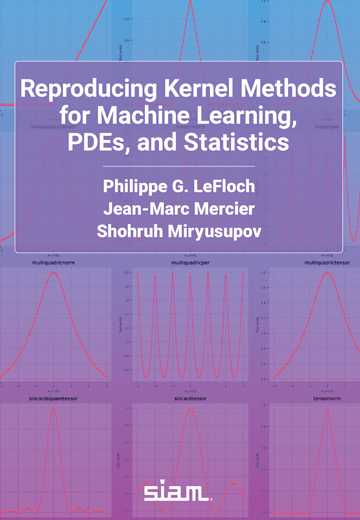
title: Reproducing kernel methods for machine learning, ODEs, and statistics Series: Other Titles in Applied Mathematics vol 212 Publisher: SIAM Year: 2026 ISBN: 978-1-61197-916-9 (pbk; 978-1-61197-884-1 (ebk) Pages: 175 pp. Price (tentative): USD 69.00 (pbk); USD 62.10 (ebk) (net) URL: epubs.siam.org/doi/10.1137/1.9781611978940 Short description: As reproducing kernels when used as an integral kernel can reproduce a function in a Hilbert space, it is clear that when the kernel and the integral are discretized, one will get discrete approximations of the function. The authors give a short introduction about these discretized kernels with their properties and then apply this theory for several applications: machine learning, approximating operators in connection with PDEs, reinforced learning, and mathematical finance. MSC main category: 65 MSC category: 65-01 Other MSC categories: 65M70 65N35 62M15 |
|
Review: To be completed The definition of a reproducing kernel Hilbert space (RKHS) is relatively simple. Consider a Hilbert space $\mathcal{H}$, then it is a RKHS if there is a symmetric (positive definite) kernel $k(x,y)=k(y,x)$ such that $\langle k(x,\cdot),f(\cdot)\rangle_{\mathcal{H}} = f(x)$. For simplicity, in this review, I will use only real variables and functions, but in general they can be complex. The general idea is that the inner product can be seen as an integral operator with kernel $k(x,y)$ applied to $f$. It is in fact the identity since it reproduces $f$. By discretization of this integral (i.e. by a quadrature formula using $N_y$ points for $y$), and by evaluating the result in $N_x$ discrete values for $x$, the whole process results in a discrete projection operator: given $N_y$ values of $f(y)$, find values for $f(x)$ in $N_x$, usually fewer and different points $x$. Similar ideas can be applied to other (integral) operators that can be expressed using the reproducing kernels. In this book, the authors approach this concept directly from a discrete point of view, that is inspired by the applications. First, each variable $x$ may consist of $D$ features $x=(x_1,\ldots,x_D)$ and moreover they may only take a set of discrete values collected in an array $X=(x^1,\ldots, x^{N_x})$, and similarly for $y$. Then $K(X,Y)=[k(x^i,y^j)]_{i=1,j=1}^{N_x,N_y}$ is an $N_x\times N_y$ array that may not be square. Nevertheless a notation like $\theta=K(X,Y)^{-1}f(X)$ is used to mean that $\theta$ is the least squares solution of $K(X,Y)\theta = f(X)$. The function $f_{k,X,Y}(\cdot) = K(\cdot,Y)\theta= \mathcal{P}_{k,Y}(\cdot,X) f(X)$ with $\mathcal{P}_{k,Y}(\cdot,X)=K(\cdot,Y) K(X,Y)^{-1}$ the projection of $f$ (given by its $N_x$ values $f(X)$) onto the space $\mathcal{H}_{k,Y}$ (spanned by the $N_y$ basis functions $K(\cdot,Y)$). In practical computations $K(X,Y)^{-1}$ is regularized by replacing it with $(K(X,Y)+\epsilon R(X,Y))^{-1}$. When the $x$ and $y$ samples are taken according to some distribution and if there is weak convergence as the number of samples goes to infinity, the continuous case is recovered. All this is covered on the first 8 pages which is quite a lot to digest when the reader is new to the subject. The remaining 15 pages of Chapter 1 give some theoretical properties, representation theorems, design of kernels, optimization procedures (with an expression for the gradient), transformations and operations for the kernels and the function spaces, how kernel-based neural networks fit into this framework, and some examples of possible kernels with the related methods, computation of the error with discrepancies, how all this is used, and some numerical examples of applications.
Chapters 2,3, and 4 are further preparations for the applications that follow in Part II of the book.\\ Chapter 2 (8 pages) deals with discrete kernel-base operators. For example the Laplace-Belrami operator $\Delta_k(\cdot)=\nabla_k^T(\cdot)\nabla_k(\cdot)$ where $\nabla_k$ is the gradient defined in Chapter 1: $\nabla=(\frac{\partial}{\partial x_i})_{i=1}^D$, and where $\nabla^T(X)$ is a divergence operator so that $\Delta_k(X)$, a matrix of size $N_x\times N_x$, is the discrete approximation for the usual Laplace operator but adapted to functions in $\mathcal{H}_{k,X}$. There are several other examples of kernel-based operators that can be seen as discretized versions, and hence approximations, of continuous (differential or integral) operators, which is how they are used in the applications considered later.
Chapter 3 (13 pages) is entitled ``Clustering strategies''. That refers to methods that, in a large data set will group together all the data that are similar according to some specific criteria. Therefore some distance or cost function $d(X,Y)$ defines how close (sets of) data points are which allows to cluster nearest neighbours in one group. Given $N_x$ points in $X$, one may place any point $y$ or set of points $Y$ in the cluster around the nearest point in $X$ and if $f(x)$ is a label assigned to the points in $x$, then the same label is assigned to the cluster around $x$, which is a semisupervised learning method. Algorithms are formulated to choose cost functions, and optimization strategies to perform this assignment problem in an efficient way. First as a general method and then specified in the context of kernels where the kernel-based discrepancy is of course an essential element. The linear sum assignment problem is an example where the elements of $X$ have to be associated with elements of $Y$ such that the total cost is minimized, which could be the trace of the cost matrix $[c(x^i,y^j)]$. Several variants of problems and methods are proposed and compared.
Another set of applications is prepared in Chapter 4 (22 pages) introducing optimal transport, which means to transform a statistical distribution function into another one while minimizing some cost function. Given a set $X$ of $N_x$ points, distributed according to $\mu$ where each point captures $D_x$ features. Similarly a set $Y$ of $N_y$ points, each representing $D_y$ features is distributed according to $\nu$. The idea is to define a transport (or push-forward) function that shifts mass distributed like $\mu$ to become distributed like $\nu$. This shifting is on a probabilistic basis and is related to Markov chains and it has a generative flavour. This is a classic problem and different methods exist using combinatorial or regularized techniques (Gromov-Monge, Kantorovich relaxation,...) with different applications (Machine learning, computer vision,...). The general principles of continuous and discrete transport methods are recalled. The key problem is to compute conditional expectations (that is the expected value of $Y$, given $X=x$) that will define the transition probabilities. Eventually this leads to numerical methods and algorithms based on the kernel framework described before. The Sinkhorn-Knopp algorithm is for example based on entropy-regularisation.
The second half of the book has four chapters, each discussing an application area of the general problems and methods derived above.
Machine learning, supervised or not, applied in regression, classification, clustering, and generative modeling, is the subject of Chapter 5. The advantages and limitations of the methods proposed before are illustrated by numerical examples. It is summarized how the previous tools can be applied in different learning strategies and what performance indicators can be formulated.
Chapter 6 is about approximating physically inspired models (mostly described by PDEs). Emphasis is on the advantages that these methods have as compared to classical approximation methods and how the RKHS operators are more natural approximations of the continuous operators. There is a discussion of mesh-free methods, denoising, time evolution equations, automatic differentiation, high-order methods. error analysis, etc.
Chapter 7 is dealing with reinforcement learning. By trial and error, decision making is being modified to arrive at an optimal strategy. Nowadays, using deep neural networks is a method of choice, but there are several possible drawbacks, so that kernel methods can be a reliable alternative but they are less efficient and do not scale well. The general setting is an agent, who observes at discrete time $t$, a state $s_t$, and accordinly takes an action $a_t$, which results in a reward $r_t$ and a new state $s_{t+1}$. This can be perfectly described by a Markov Decision Process (MDP) and the goal is to find an overall strategy that maximizes the reward over $T$ time steps, i.e., maximize $\sum_{k=t}^T \gamma^{k-t} r_t$ where $\gamma\in[0,1]$ is a forgetting factor. The decision of what action to take given the current state can be computed on the basis of probabilistic state and action functions described by Bellman equations based on a stored sequence of the past history. Classical methods are surveyed such as Q-learning, optimizing the policy using a gradient based method, or Hamilton-Jacobi-Bellman equations (a nonlinear PDE for which a controller is computed), etc. Several kernel based methods are proposed for the previous approaches, and their advantages are illustrated numerically. The methods can also be applied for clustering.
The last chapter 8 contains illustrations from mathematical finance. Of course (nonparametric) time series modeling are essential for forecasting. Also pricing functions (conditional expectations of future values) are important and are often modeled using Monce Carlo simulations or are solutions of differential equations, but kernel methods can provide (differentiable) approximations and risks in real time. Applications include a (reverse) stress test problem and portfolio management. Everything is amply illustrated with numerical examples.
This review may illustrate that this is not the place where you should start to learn how to use these methods, but for the researcher or practitioner (in any of the diverse applications) it is an inspiring survey where some methods they may be familiar with are placed in a broader framework.
The authors have several papers on different aspects and applications and they have written this book as a round-up of what they have achieved in different applications. In that sense it is a research monograph.
It is certainly advertising kernel based methods as being the better approach in most cases.
Although some of the proposed methods resulted in algorithms, they are not described in such detail that an implementation on a computer will be straightforward.
The mathematical descriptions are kept to a bare minimum and it may need some imagination to figure out what exactly the dimension is of the tensor/matrix/vector that is represented by a symbol. For example it is not always clear whether a notation $\mathbb{R}^{N_z,D_f}$ refers to a matrix of size $N_z\times D_f$ or not.
A index $k$ when used as an index may refer to an integer, but at other places it refers to the kernel $k$, which is somewhat confusing in the beginning.
It is a great help that each chapter starts with a summary of what will be covered in the sections to follow.
A list of 108 references is not very extensive, but it is probably sufficient for the kind of (somewhat specialized) readers that the authors are addressing here.
On the other hand, given the broad scope of mathematical techniques and applications that is covered, only one page for the subject index is a bit disappointing.
Reviewer: A. Bultheel (KU Leuven)
© October 22, 2026