|
Author(s): Jonas Peters and Nicolai Meinshausen
title: The raven's hat Publisher: MIT Press Year: 2021 ISBN: 9780262044516 (pbk) Pages: 192 pp. Price (tentative): USD 24.95 (pbk) (net) URL: mitpress.mit.edu/books/ravens-hat Short description: The authors present a broad selection of mathematical problems that are easy to formulate and understand, but that require a careful analysis to solve them. The problems are presented as games or puzzles, and their solution is used as a pretext to introduce some necessary mathematics. The enchantment of the puzzle is an incentive for the reader to assimilate the necessary mathematics. Published: EMS Magazine vol. 121, pp. 55-56, (2021) MSC main category: 00 MSC category: 00A09 Other MSC categories: 00A08, 03-01 |
|
Review:
This book introduces, with some variations, eight mathematically flavoured games or puzzles. As the authors accurately explain in their preface, the type of problems they present look at first sight almost impossible to solve. It is only after a careful analysis, reducing it to a formal (say mathematical) reformulation, that it becomes clear that a solution strategy can be designed that is in some sense even optimal. Each time, the discussion of the solution to a problem is taken as an excellent pretext to explain some piece of mathematics. A reader with a minimal mathematical background will learn what a Hamming code is, what a cyclic group is, and even some elements of linear algebra, probability, and even broader topics such as information theory, projective geometry, and algebraic topology. What starts as a playful game with a seemingly impossible solution becomes, after placing it in an appropriate mathematical context, relatively easy to solve. Moreover, by isolation and abstraction of the essentials, it becomes simple to consider more general situations. A better advertisement for the power of mathematics and a stronger motivation to study mathematical formalism and mathematical structures can hardly be found.
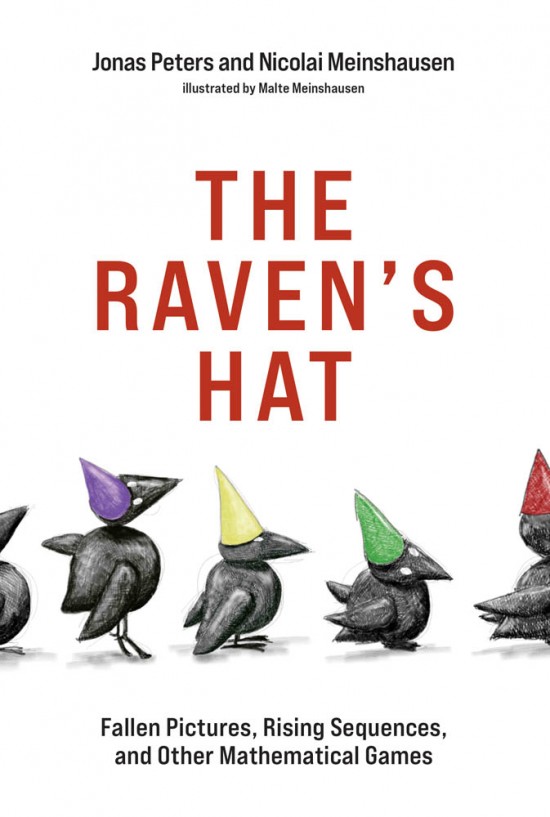
The book opens with a classic game, which is also for the title of the book. So let’s take this as an illustration of the concept used by the authors throughout. Consider three players (in this book the players are adorable ravens illustrated in graphics by Malte Meinhausen). Each player has a blue or red hat on his head. They see the other players but they cannot see the colour of their own hat. All players have to guess their own hat’s colour (red, blue, or don’t know) without communicating with each other. The players, as a team, win the game if at least one player is correct and none is wrong (where the don’t know answer is not considered wrong). There exist innumerable variations of this type of game, generally called ”hat-problems”. The present problem, which asks for a successful collective strategy, was originally formulated by Todd Ebert in 1998. It was Elwyn Berlekamp who later connected the solution to coding theory and solved it for $n$ players when $n$ is of the form $2^m − 1$. The solution for general $n$ is still an open problem today. This kind of (brief) historical background of the problem is also given for the problems presented in the other chapters, which is a nice feature of the book. To work towards solving the problem, the authors first propose some guessing strategies or naive trials, possibly introducing a first formalism such as coding the red-blue colours as 0-1 and the configurations of three hats as binary numbers from 000 to 111, with the first bit for player 1, the second for player 2, and the last for player 3. This shows that there are a total of 8 possible states, and each player knows 2 of the 3 bits in the true number and must guess the bit of her own position. The probability of winning for the 3 players is maximized if each player chooses her own colour (0-1 bit) so that the ”distance” to one of the $8 = 2^3$ possibilities is minimal. The crux is to define this distance as the Hamming distance, which is the mathematical contribution to the solution in the form of coding theory. Once the principle is clear, it is easy to generalize the solution to $n = 2^m − 1$ players. This problem involves some elementary probability, and probability is also an ingredient for several of the other problems discussed in this book (both of whose authors are professors of statistics). Several variants of the game correspond to the following description: a set of players needs to guess something on the basis of partial information that is available to them, and the goal is to agree on a strategy that will maximize their chance of winning the game as a team. For example, in the second game of this book, the $n$ players have their name hidden in $n$ boxes, and they have to find the box with their own name in a minimal number of trials for the whole team. Here the mathematical tool is the factorization of a permutation into cycles. In the existing literature, the players are often presented as prisoners that are collectively freed if they win. In this book, the stories vary, but all the illustrations portray ravens with hats.
Let me skim more quickly over the other chapters. Somewhat related to the two hat-problems mentioned above is a problem where there are more colours for the hats and where the players are lined up in such a way that each player can only see the other players (and their hats) who are positioned in front of them. This seems to contain strictly less information than when they can all see each other, but when the players start guessing the colour of their own hat one after another, starting with the one at the back, the extra information is provided. Here it is cyclic groups that come to the rescue to solve the problem. Another game is a magical card trick which is based on understanding correctly how much randomness is introduced in an ordered card deck by riffle shuffling or cutting the deck. While the previous problems involved simple counting, a bit of probability, and basic algebraic concepts, there is no way around introducing the logarithm when information theory is involved. Not that the logarithm is an advanced topic, but still it requires some understanding of mathematics beyond counting. A further game introduces some projective geometry with a pinch of graph theory. Somewhat of a different nature is the problem involving two globes placed randomly on the table, in which one is asked to find the place or country that are in the same (or opposite) position on the two globes. This means that the axis defined by the position of that place on globe 1 and the globe centre should be parallel to the corresponding axis for globe 2. For this problem, one needs to realize that there is a mathematical one-to-one match of the two globes by a translation (to match up the centres) and a single rotation. The axis of the latter gives the solution. This requires the introduction of some linear algebra to see that the problem is a simple eigenvalue problem for a 3D rotation matrix. The final game is, once again, a classic, involving hanging a picture on a wall. If there is one nail on which the frame string can be hooked, then the picture will fall when the nail is removed. The game is to wind the string of the frame around two (or more) nails in such a way that if one nail is removed, the frame will not drop to the floor. Here the naive reader is confronted with group theory and algebraic topology to find a general solution.
For an inexperienced puzzler, the problems look challenging at first sight, so she is gradually guided by the authors towards a solution with several variants of naive trials, pointing at the shortcomings, and just enough mathematics is used to deal with the problem at hand. If, in a top-down approach, the mathematics were to be introduced first with the problem solution as an a posteriori application, this approach would not have the same motivating effect. A simple problem that has a hard solution leads to mathematics that not only solves the original problem, but that can immediately be applied to generalizations and other variants of the problem. For readers who are attracted to solving puzzles and games, but who have a weak (or no) mathematical background, the authors provide several appendices with additional explanation of notation, binary and complex numbers, converging sequences, probability, etc. as well as some extra details on specific problems discussed in the chapters. This is an engaging book that all puzzlers, and certainly novices to the field, will love.
See also pdf version.