|
Author(s): Marcus du Sautoy
title: Thinking Better: The Art of the Shortcut Publisher: Basic Books /Fourth Estate Year: 2021 ISBN: 978-1541600362 (hbk); 978-1541600379 (ebk) Pages: 336 pp. Price (tentative): USD 30.00 (hbk); USD 17.99 (ebk) (net) URL: www.basicbooks.com/titles/marcus-du-sautoy/thinking-better/9781541600362/ Short description: This is an entertaining account about the many ways mathematics, and consequently also science in general, has invented or discovered ways to advance. This corresponds to more direct and shorter ways to solve the problems at hand so that one can move on to tackle more difficult problems. These shortcuts save us the time to investigate all possible roads, they allow us to predict the future without living it, or to measure the cosmos where none has gone before, or to manipulate data and analyze relations too numerous to grasp. Published: MAA Reviews here MSC main category: 00 MSC category: 00A09 |
|
Review:
The shortcut, the shorter way to reach your target, that is what this book is about. The shortest path from A to B is the straight line. That is the natural way that elephant path emerge in parks if no precautions are taken. But that only holds in Euclidean geometry and shortcuts are not always that obvious. The most obvious path followed by our brain to solve a problem is not always the shortest. A classical stereotypical example, legend or not, is how the young Gauss added the numbers from 1 to 100. Adding 1+100, 2+99, 3+98,... gives 50 times 101 or 5050. His teacher's intention was that the class should add 1+2+3+... to keep them busy for a while, but Gauss's answer came almost immediately. This is the kind of shortcuts that Marcus du Sautoy is after in this book. His message is that these less obvious shortcuts are the way to success, they form the engine for the progress made in science, and they are the essence of mathematics. It is not a coincidence that the summing example appears in the beginning of the book because it is is obvious that Gauss is one of du Sautoy's mathematical idols, since Gauss returns as a hero or at least as a sidekick in practically every chapter.
This book made me realize that since we were a child, we constantly learn how to do things better and more efficiently, and that nearly everything we do, involves a learning process that shows us the shortcuts to do things better the next time we have to solve the problem. Actually it is not only a matter of nurture. When considering the long term evolution, then in a way, nature itself also has learned to find shortcuts for the best way to evolve.
Although the titles of the ten chapters refer to mathematical subjects and the main story is indeed about mathematics, there are many excursions to broader social aspects and everyday life. These are most explicit in the somewhat shorter "pit stops" that is attached to every chapter. These pit stops are usually the result of an interview or a meeting with a person who represents, or has explicit ideas, related to the subject discussed in the preceding chapter but in a quite different social context.
But let me be more concrete by scanning the contents. In a first chapter, the way to detect a shortcut is by recognizing some pattern in the problem tissue. A repeating pattern allows us to predict the solution, the outcome or the future. That holds for astronomical observations as well as for summation formulas for number sequences and for the analysis of economic time series. The associated pit stop is discussing music patterns and the ability to recognize a pattern versus the amount of training one has to put into a subject in order to master it.
With a brief history of our number systems, it is illustrated how our efficient way of denoting numbers and doing computations improved the way in which our society functions. Thinking outside predefined roads is a way to find a shortcut like elephant paths or accepting an imaginary number as the square root of a negative number. Thinking outside the box is often the basis for a start-up that becomes a billion dollar business.
Under the heading `the language shortcut' du Sautoy collects a number of mathematical topics that could take advantage of the way in which the problems are framed or denoted, like our way to denote and manipulate formulas, or how we deal with higher dimensional problems talking about `spaces' and `coordinates' generalizing lower dimensional notions that are familiar and can be visualized.
One picture is worth a thousand words is the idiom that somehow places geometry at the focus as a source of shortcuts. Geometry helped the ancient Greek to calculate the distance to the moon, surveyors to measure the world, navigators to find the shortest route on a globe, Einstein to rethink the geometry of space-time, and cosmologists to predict the future of the universe.
It could have been in the chapter on notation or in the previous chapter, but diagrams have also shown to be a great help to solve a problem or to `see' a shortcut to its solution. Venn diagrams can visualize solutions to logical problems, geographic maps and molecular or Feynman diagrams, describe realities that are difficult to represent otherwise. A word of caution is in place here because spin doctors of companies or political parties may present the graphics in a very deceiving way.
At first, I was somewhat surprised to see calculus announced as a major way to achieve a shortcut. But if you think of finding the `best' solution to a problem measured by some criterion that has to be optimized, then, under some conditions, it reduces to finding a zero of a derivative, which is way simpler than finding an optimal solution by trial and error. It is essential for architects, engineers, and scientists to do what they do and to realize what would not be possible without calculus in a reasonable time or within a reasonable budget.
One of the buzz words and a main research topic of the last decades is `data science'. We are constantly spammed by numbers that are the results of numerous polls trying to convince us to buy or do something. These polls should however be properly designed. But even if there are numerous extreme outliers in the answers, the average can still be close to reality. There is some self-regulating wisdom in the crowd. The average person does not exist, but it is still possible to describe how a group of persons will behave. It requires a honest and proper design to extract this wisdom from the massive amount of data produced the crowd.
Of course probability is an essential tool to analyze a lot of samples. But again here, it takes wit to apply the tool in a proper way. Bayesian statistics and (in)dependence of the variables are important to estimate probabilities and correlations, but one should not confuse correlation with causality. It takes much caution to rely on shortcuts created by models manipulated by computers that govern the stock market nowadays. Bond options allow the investor to make profit even if the bond is decreasing in value. But beware. The stock market is populated by computers. They trust blindly any given inaccurate model not catching the emotions or intentions of a large crowd of small investors and they react instantly without a second thought.
Networks are the shortcut to analyze all the connections that are boosted by the big internet business and that are creating the big data to be analyzed. While Euler initiated graph theory when solving the problem of walking the seven bridges of Köningsberg connecting four areas, the mathematical analysis of graphs is now a discipline analyzing our social networks, automatic grading systems, and simulating the connections in the human brain.
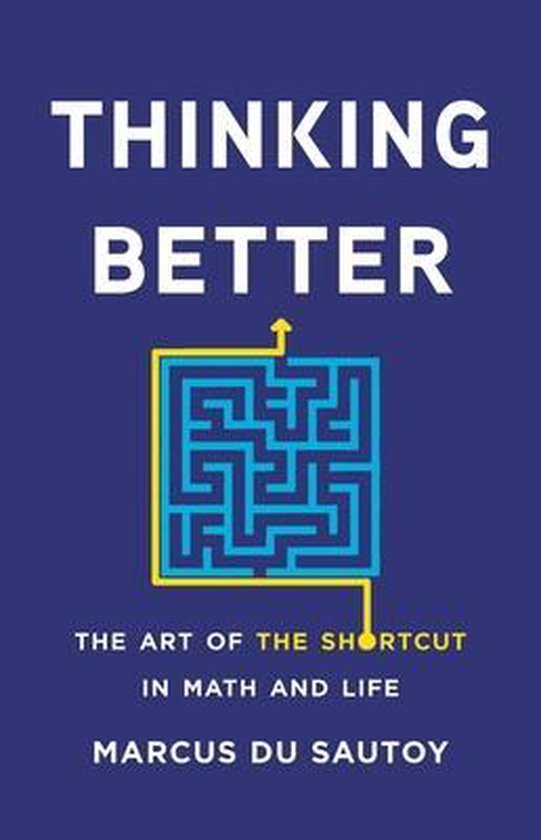
In the final chapter, we meet the, yet unsolved, hypotheses and conjectures like P vs NP problem, of which the travelling salesman problem is a typical example. But it is also illustrated how long standing conjectures that were eventually solved have lead to new branches of mathematics that would perhaps never have been explored or not that soon. The shortcut is clearly not always an obvious step to take and it requires to find your shortcut as a path through a labyrinth as it is beautifully illustrated on the cover of the book. If we have not found a way to solve the problem yet, it is not a reason to despair. Du Sautoy points to new computer models like quantum computing or biological computers as a way to find the road through the labyrinth.
Marcus du Sautoy is the Simonyi professor for the public understanding of science, and he has once more illustrated in this book why he got that nomination. Although most of its contents is about mathematics, there are practically no formulas or complicated technical discussions. There is history as well as current applications and excursions to many non-mathematical topics. Everything is told in an entertaining way, not trying to be funny in an absurd of unnatural way. Each chapter could be a public lecture to entertain a general audience. Some stories are well known among mathematicians but there is a pinch to be learned that cannot be found elsewhere.
Will this book learn you how to function better in life as the subtitle claims? I doubt that it contains a non-mathematical prescription for that. We can certainly learn from mathematics and since mathematics is everywhere... And there are these pit stops telling about people having booked successes in life by applying some ideas that were discussed before in a mathematical context. Remember that we may learn from examples, seeing a pattern, and perhaps, putting the pieces together, finding a shortcut for our own situation. Thinking outside of the box is not a guaranteed success, but sharing ideas with experts from different disciplines has been successful in many cases. Each chapter also starts with a short puzzle that the reader should think about. It usually does not have an easy solution, but the solution becomes obvious in the end after the general principle has been explained and the shortcut lets the aha!-solution drop out immediately. I can warmly recommend mathematicians and non-mathematicians alike to read this very entertaining reflections on many different disguises of the shortcut.
The shorter version, published by MAA.
Reviewer: A. Bultheel (KU Leuven)
© December 16, 2021