|
Author(s): Mackenzie, Dana; Sloman, Leila
title: What's happening in the mathematical sciences. Vol. 13 Series: What's happening in the mathematical sciences Publisher: AMS Year: 2024 ISBN: 978-1-4704-7490-4 (pbk) Pages: vi+128 pp. Price (tentative): 29.00 USD (pbk); (net) URL: bookstore.ams.org/view?ProductCode=HAPPENING/13 Short description: This is again a marvelous insightful collection of topics explaining recent advances in mathematical research to a broad readership, which is straight to the heart of any math lover. Published: zbMATH Open Zbl 07871968 MSC main category: 00 MSC category: 00A09 Other MSC categories: 00A05 00A06 00B15 |
|
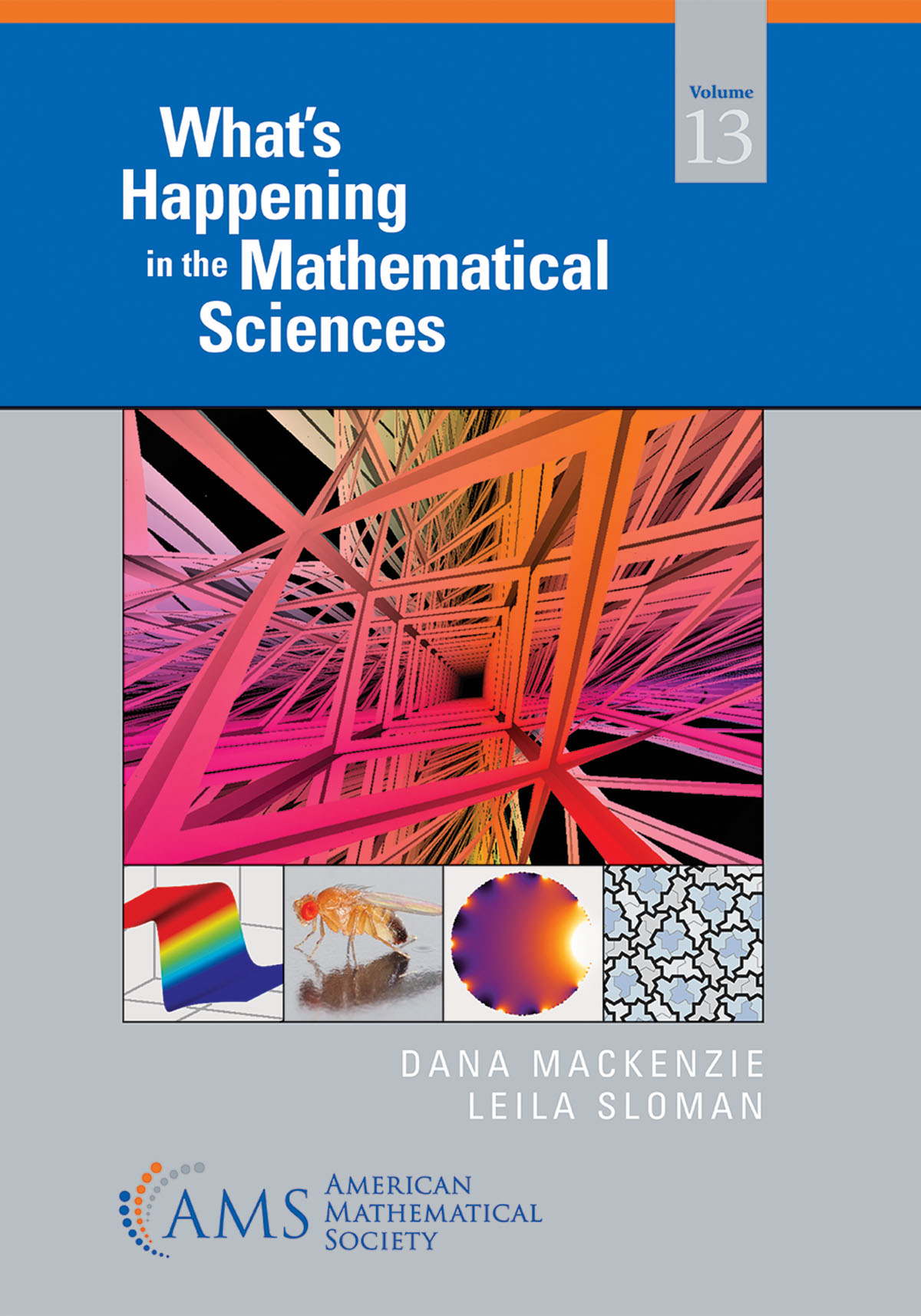
Review:
Dana Mackenzie has been a contributor to previous volumes of this series since 2006 and became the successor of Barry Cipra. This series brings notable new developments in mathematics are explained for a broad readership. In this volume Dana wrote six of the 9 surveys, and he is joined for the first time by Leila Sloman who wrote the other three. Sloman is a regular contributor for Quanta Magazine, an online magazine that has about the same objectives as this series, except that it is covering a broader range of science topics not restricted to mathematics alone.
Although the contributions make the subject accessible for outsiders, they explain true advances in mathematical research. In this volume subjects are geometry, number theory, and artificial intelligence.
The first topic is aperiodic tiling of the plane, researched with renewed interest since Penrose tiling (1974) gave rise to a Nobel prize for discovering quasicrystals. Only recently a continuous family of single tiles was found, questioning the nature of quasicrystals.
The last topic in this volume is about sphere packing and sphere kissing in an $n$-dimensional Euclidean space. Kepler estimated the densest packing in 3D was about 74\%, which was proved to be true in 1998 by T. Hales, but it was unknown for $n>3$ until M. Viazovska found a proof for $n=8$ using a magic function, which was soon adapted for $n=24$. For the other dimensions only an upper bound is computed via infinite dimensional linear programming. This bound seems to be related to spectral gaps in quantum gravity.
W. Thurston conjectured that all 3-manifolds can be decomposed in 8 types with a different geometrical structure. Sloman summarizes the effort of a team that is visualizing these geometries, not only on a screen, but even making it a VR immersive experience.
Somewhat less accessible for outsiders is a section on Fano varieties, which are certain complex solution sets of polynomial equations. It is difficult to characterize their curvature and classify them in several families (moduli spaces) according to their topological properties, until in 2022 $K$-theory from differential geometry came to the rescue to unravel a 1993 conjecture by Yau-Tian Donaldson.
A recent number theoretic result states that there are infinitely many prime numbers that do not contain an arbitrary chosen digit in any base larger than 10. The proof relies on J. Maynard's method using Fourier analysis to count them.
The chaotic behaviour of nonlinear dynamical systems such as the brain makes it difficult to detect a causal relation between the variables. Based on a theorem by F. Takens from 1981, researchers could now detect causality between neurons in the brain of a fruit fly, but this also applied to other chaotic systems.
Somewhat related are unstable singular solutions of the Navier-Stokes equation from fluid dynamics. There is a long history of detecting and describing the singularities (e.g. vortices) in solutions of this equation or some of its simpler forms. Nowadays, even neural nets are used to detect them.
The problem of reconstructing a 3D scene from a few 2D pictures relies on how well corresponding pixels are matched. Also here, modern techniques rely on learning algorithms to detect outliers.
This brings us to the remaining paper dealing with artificial intelligence, which it today's hottest topic of them all. It is explaining neural nets and how the learning process relies on minimizing a complicated cost function. A simple technique of skipping connections in the neural net can smoothen this cost function, making it easier to find a global minimum and avoid hallucinations.
So, this is again a marvelous insightfull collection of topics straight to the heart of any math lover.
See the reviews of previous volumes. 1, 2, 3, 4, 6, 8 11 and 12 in Zbmath [ Zbl 0858.00003; Zbl 0858.00004; Zbl 0858.00005; Zbl 1028.00002; Zbl 1242.00011; Zbl 1244.00007; Zbl 1326.00011; Zbl 1266.00007; Zbl 1326.00016; Zbl 1326.00017; Zbl 1477.00003; Zbl 1520.00005; ] and my reviews of vols. 7, 8, 11, 12 in the NCM/BMS Newsletter
Reviewer: A. Bultheel (KU Leuven)
© November 22, 2025