|
Author(s): Claudi Alsina and Roger B. Nelsen
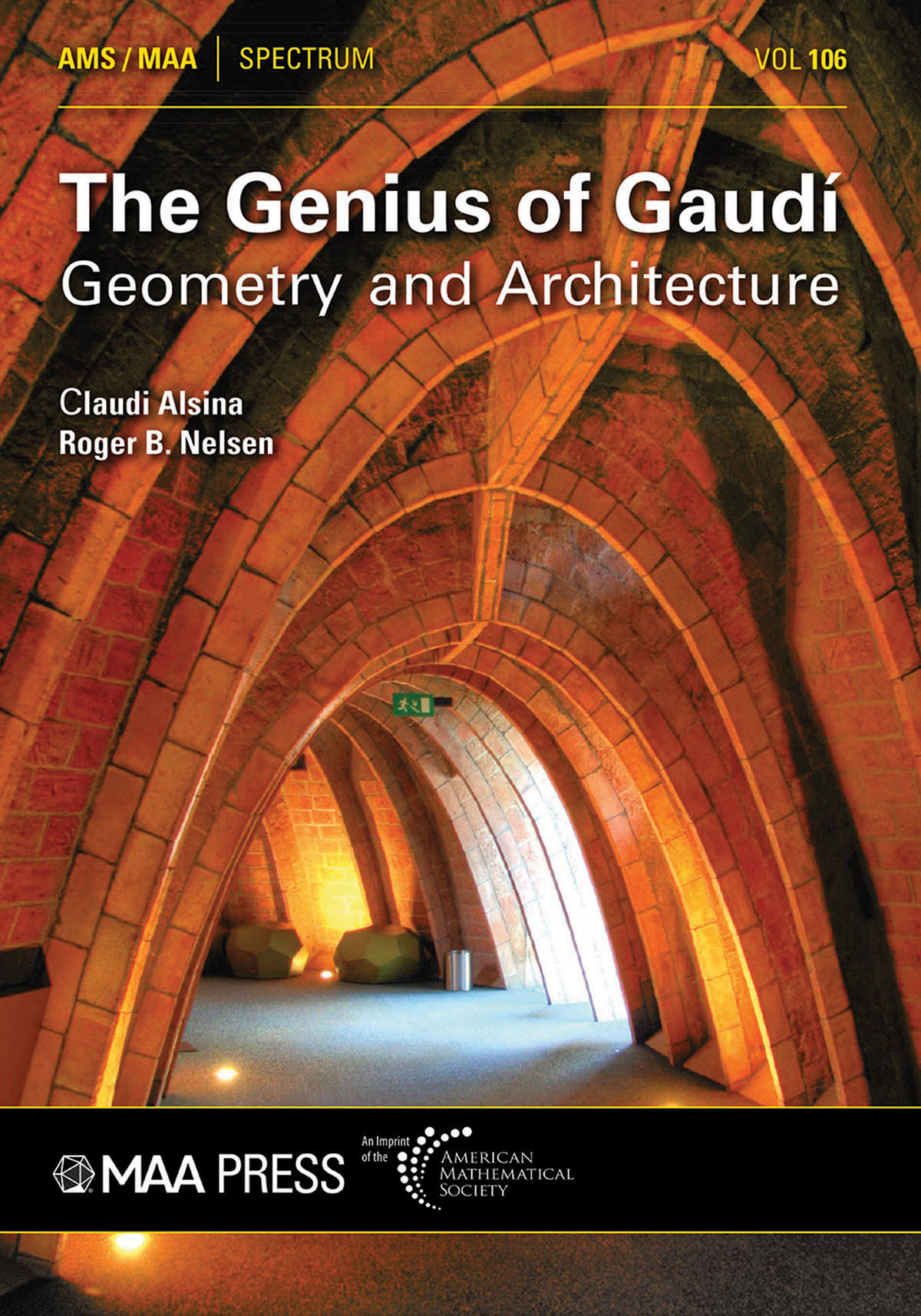
title: The genius of Gaudí. Geometry and architecture Series: AMS/MAA Spectrum, vol. 106 Publisher: MAA Press Year: 2025 ISBN: 978-1-4704-7922-0 (pbk); 978-1-4704-8047-9 (ebk) Pages: xiii+171 pp. Price (tentative): USD 69.00; (pbk); (net) URL: bookstore.ams.org/spec-106 Short description: This is an easy to read and amply illustrated booklet about some geometry that is used in the buildings designed by Antoni Gaudí. Published: zbMATH Open Zbl 08023306 MSC main category: 00 MSC category: 00A67 Other MSC categories: 51-01 14J26 52C20 51M20 51M04 |
|
Review:
In this marvelously illustrated booklet, the authors bring an ode to the architect Gaudí by showing the intrinsic geometry that is hidden in the organic curved shapes that can be found in his creations. The straight lines of classical constructions transform into the perkyness of Gaudí's buildings, often by lifting the first degree descriptions to second degree equations.
So the mathematical aspects start with discussing properties of plane curves in particular the ellipse, parabole and hyperbole, and the closely related catenary. Their mathematical properties also allow practical construction methods for these curves. In 3D we are introduced to quadratic surfaces in particular the ruled surfaces among them are interesting for construction, but also other ones like conoids and helioids are interesting ruled surfaces. Stacking circles or spheres leads naturally to tilings of the plane and sphere packing. Tiling is important for paving and mosaics abundantly used by Gaudí. So the reader is exposed to several properties of polygons, and even the Reuleaux triangle. The Platonic solids and stellar polyhedra are used by Gaudí as ornaments. They are the main 3D objects being discussed. Finally, in a `miscellany' chapter one can read about other mathematical objects in relation with Gaudí like a toroid, his enigmatic magic square, the double helix, the construction of a 15-gon and optimal positions to take a picture. The starting point for all these mathematics is always the work of Gaudí, with special attention to the Sagrada Familia of the mathematical properties mentioned are proved, requiring a minimum of mathematical knowledge. It is noteworthy that many of these properties are not traditionally found in a textbook of a regular curriculum. For example showing that the 2D equation for a conic section corresponds to cutting a 3D cone by a plane is usually introduced showing a picture, but it is not so obvious to really prove it. There are also several optimization problems like finding the cone with minimal surface that covers a fixed volume, etc. Therefore the book will not only enchant the admirers of Gaudí's work but it can also be used as a supplementary source of inspiration for a regular geometry course.
Reviewer: A. Bultheel (KU Leuven)
© September 21, 2025