|
Author(s): Chris Bernhardt
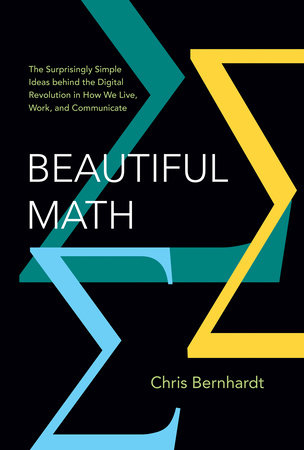
title: Beautiful math. The surprisingly simple ideas behind the digital revolution in how we live, work, and communicate Publisher: MIT Press Year: 2024 ISBN: 978-0-262-54977-6 (hbk); 978-0-262-38074-4 (ebk) Pages: xvi, 221 pp. Price (tentative): USD 27.95 (hbk) (net) URL: mitpress.mit.edu/9780262549776/beautiful-math/ Short description: This is a lay-man introduction to illustrate the many mathematical tools that are needed to make our digital communication possible. From Fourier transformation over coding and encryption, to logical functions and learning methods and neural networks in artificial intelligence. Published: zbMATH Open Zbl 07897303 MSC main category: 01 MSC category: 01-01 Other MSC categories: 00A09 |
|
Review:
The ambitious goal of the author is to introduce the lay reader to the wide spectrum of mathematics used in all aspects of current digital communication. In particular to the mathematics that made it happen since the rise of digital computers. That clearly includes different forms of Fourier transforms used to transform analog information into a digital form, but also encoding, compression, error correction, transmission, encryption, logical circuits, and machine learning. To keep the presentation accessible, the concepts are introduced in the simplest possible case.
After emphasizing the importance of the digital revolution of the 20th century, and introducing the concept of an alphabet, the general setting is down-scaled to a binary situation. In this situation it is possible to introduce the concept of information and entropy as it was defined by Shannon. Since most text (a collection of binary strings) is redundant, it triggers the possibility to encode and compress the information (the Huffman code is explained). When sent over a communication channel and because compression can be lossy, there is a need for error correcting codes (the Hamming code is explained and a proof of Shannon's noisy channel coding theorem is sketched). If secret messages need to be communicated, they have to be encrypted (the symmetric key and private key encryption like AES and RSA are explained).
Only at this stage, the essential transition from analog to digital information is discussed. The (Fast) Fourier Transform and Nyquist sampling theorem are more mathematically demanding issues and some technical material is moved to the appendix. Also the remaining chapters are a bit more advanced. The arrival of electronic computing machines after World War II, the concept of algorithm to keep these machines running came to the foreground which leads to problems of computability. After a brief overview of how relais for switching systems were replaced by transistors to realise logical expressions, even the fundamental incompleteness theorems of Kurt Gödel and the Entscheidungsproblem are discussed. Especially the Church-Turing halting problem with Turing's universal machine get special attention with extra information in an appendix. While algorithms initially executed what they were instructed to do, they evolved to a simulation of the human brain and so it is explained how algorithms can be trained to recognize patterns by supervised methods or learn on their own with unsupervised methods. There is a somewhat oversimplified explanation of the steepest descent algorithm to optimize the performance, and how these algorithms are implemented via neural networks.
Although the main idea of the book is primarily to discuss the mathematics underlying the issues discussed, this is not a math course. Topics like entropy (combinatorial arithmetic and logarithms), Fast Fourier transform (trigonometry, matrices, and complex numbers), the RSA algorithm (prime numbers and modulo calculus), clearly require some formulas, but most of them are moved to the appendix. The story is told in an entertaining way with a lot of historical and biographical notes. This is not the place to learn all the details of the mathematics or of the practical implementations, but rather to sparkle the interest in these mathematics and to illustrate the importance of mathematics in everyday's life.
Reviewer: A. Bultheel (KU Leuven)
© February 13, 2025