|
Author(s): Stéphane Douady, Jacques Dumais, Christophe Golé, Nancy Pick
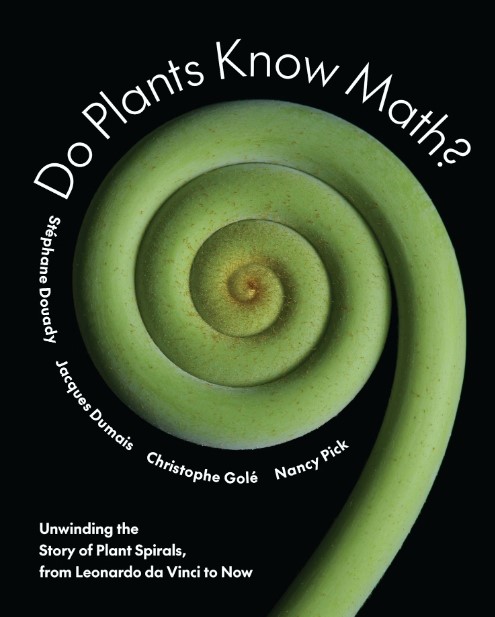
title: Do plants know math? Publisher: Princeton University Press Year: 2024 ISBN: 9780691158655 (hbk); Pages: 352 pp. Price (tentative): USD 27.95 (hbk) (net) URL: press.princeton.edu/books/hardcover/9780691158655/do-plants-know-math Short description: A physicist, a mathematician, a biologist and a science writer tell us the history of the phyllotaxis and how from da Vinci to current researchers have tried to unravel why the Fibonacci numbers and the golden section is so omnipresent in the botanical world. A pdf version with illustrations also appeared in the NMS/NCM Newsletter. See here Published: EMS Magazine vol 136, pp.65-67 (2025) MSC main category: 01 MSC category: 01-01 Other MSC categories: 00A79 |
|
Review:
Since N. Pick, an American science writer, heard S. Douady, a French physicist, discuss the Fibonacci numbers and the golden ratio during his lecture, they joined forces to start this book project. Later they were able to convince J. Dumais, a Canadian biologist, and C. Golé, an Algerian-born mathematician, to join. All of them are fascinated by the fact that these Fibonacci numbers continuously appear in phyllotaxis and more generally in nature. This book reports their search for an answer to the intriguing question: why is nature is so 'obsessed' by these numbers?
The book starts by explaining the terminology. There are of course the Fibonacci numbers and the golden ratio, appearing in the spiral—or the helix—that can be connected with how plants grow leaves along their stem, but also to the spirals that can be observed in the seeds of sunflowers, pine cones, or pineapples. They are called parastichies in phyllotaxis, and are characterized by 2 integers n and m: new leaves appear after a turn of n/m of a complete circle (the divergence angle) around the stem and these numbers turn out to be Fibonacci-like with a golden angle of about 137.5◦ in the limit. They also refer to there being n left turning spirals and m right turning ones. Later in the book concepts such as dynamical systems, fractals, grids, and circle packing will be introduced. And there are the biological terms such as meristem, which is the tip where the plant grows. It contains the stem cells that differentiate and grow into primordia, which will develop into the plant's organs like leaves, petals, etc. From the beginning the authors take the reader along on their journey encouraging them to observe patterns in nature, explore the many marvelous illustrations in the book, and even complete homework assignments to make crafts to verify the claims presented.
The authors tell the historical development of the subject from antiquity up to their own involvement. Each chapter starts with a `Fibonacci poem’ having seven lines where the number of syllables on each line forms a Fibonacci sequence. Between the introduction and the conclusion, the main body of the book is arranged into five parts, each consisting of several chapters: (1) the early recognition of Fibonacci numbers and golden ratio in mathematics and nature; (2) how science became interested in the topic, and what additional information was revealed by introduction of the (3) microscope, and later the (4) computer, and how (5) biologists investigated new tracks at a cellular level, eventually attempting to answer the why-question.
So we start with the number sequence recognized long before Fibonacci in ancient Egypt and in Sanskrit poetry, move on to Leonardo da Vinci (who had a notebook classifying different kinds of leaves growing on plants) and of course Fibonacci (with his legendary example of population growth in rabbits), to Kepler, (whose mother was a herbal healer, accused of being a witch) who tried to fit the planetary system into the mathematical rules of Platonic solids and who, in his treatise on the six-pointed snowflake, observed that the ratio of Fibonacci numbers approached the golden ratio, a concept traditionally attributed to Luca Pacioli.
Charles Bonnet (1720-1793) explained the placement of leaves as being optimal because he thought that plants grew by absorbing the dew coming from below. The word phyllotaxis seems to be coined by Karl Schimper in 1830 who observed the spirals in the placement of the leaves on a stem and of scales in a pine cone. But it was Alexander Braun who introduced it in his book, marvelously illustrated by drawings of his sister Cécile. In 1837, the Bravais brothers (one of them was trained in crystallography) linked these spirals to plane grids (representing the surface of the cylindrical stem) defined by the n/m ratio. On this basis Braun identified a continued fraction that converged to the irrational number (3−√5)/2 and this is the portion of the circle giving the golden angle.
Wilhelm Hofmeister (1824-1877) rejected the prefixed spirals, and looked at cell growth with the microscope. Swiss biologist Simon Schwendener (1829-1919) took a mechanical approach considering cells on the stem surface to be circles. Stacking of these circles that grow as they age, determines that a leaf starts growing where there is the most place available. The Dutch botanist Gerrit van Iterson Jr. (1878-1972) described possible solutions by a bifurcation diagram (1907), which has become a standard item in today's phyllotaxis. One may notice these different branches as irregular transitions occurring for example where the scales of the pine cone have different sizes. The Fibonacci branches are chosen by minimizing the energy.
Then we arrive in the computer age with Alan Turing (1912-1954) who applied a theory of diffusion to explain biological patterns like the stripes of a zebra or the spots of a leopard. Much later this evolved in chaos theory and (nonlinear) dynamical systems. Near the end of his life Turing worked on morphogenesis and phyllotaxis, but, unfortunately, he did not live to see it published. His notes, including the hypothesis of geometrical phyllotaxis were only released 40 years after his death when Douady published related results at approximately the same time.
Meanwhile Aristid Lindenmayer (1925-1984) and Arthur Veen studied spirals in sunflower seeds. Lindenmayer modeled plant growth using what became known as L-systems, which established a formal computer language with an alphabet representing different elements and rules for their interaction. Their simulations on the diffusion of growth inhibitors produced very realistic images of sunflowers.
Douady shows with lab experiments on repulsing magnetic droplets and numerical simulations that, because the Schwendener circles grow as they move along, there are actual gaps at the bifurcation points of the Iterson diagram. This implies that always the Fibonacci branch is taken, as earlier explained by Iterson on the basis of an energetic argument. Primordia in plants appear not only where, but also when the occasion is favorable.
That did not work for corn, which Douady considered a monster generated by extensive breeding but here the work of Dumais and Golé comes in to explain the zigzagging growing front. Near the center of the meristem, the cells have different sizes, which explains an irregular (i.e., not hexagonal but rhombic) grid in the circle packing and hence the zigzag front. The teeth of the zigzag line are formed by the m left and n right spirals intersecting the growing front at different angles. Therefore the rhombic pattern will, at some point in the growing process, produce a degeneration in the form of a triangle or pentangle, explaining the choice of Fibonacci branches.
What follows is a relatively short intermezzo on fractals and kirigami (the art of folding paper and cutting it to get particular effects when unfolded). Fractals describe accurately the shape of broccoli, ferns, leaves, etc., and kirigami is applied to show how leaves are packed in buds before they unfold.
But then they return to spirals from a biologist's point of view. As in physics, there are the empiricists who observe and do experiments and there are the ones who try to explain everything through mathematics. Here cell division is studied using a mathematical soap bubble model, something observed by the Belgian botanist Leo Errera (1856-1905) inspired by the work of Joseph Plateau (1801-1883) and popularized by D'Arcy Wentworth Thompson in his famous book On Growth and Form (1907). Cells divide such that they form minimal surfaces, but there are small deviations. Depending on their shape, divisions of cells can happen at local minima rather than at the global one. Then Douady used dynamical systems again to show that cell division converges to an attractor and the generations of offspring cells will arrange again in spirals throwing us back, in a fractal-like way, to the same story all over.
The authors add a chapter on animal analogs of the same story, like the spiral of the nautilus shell, the spiral patterns of the scales of fish or snakes, the tail of a peacock, or the multi-faceted eye of a fly. However, the Fibonacci sequence is not so frequent here, which might be explained by the mirror symmetry in animal bodies.
So, what is the conclusion? Do plants know math? The authors' answer is that these mathematical patterns are just the result of morphogenesis, and that there is no mathematical god that imposes it on nature. Each plant cell is just following the basic laws of science, and as the plant grows, the patterns spontaneously arise.
To finish with a celebration dinner, the last chapter presents several recipes to cook the plants with all their fantastic patterns, to make use of what they are really good at—i.e., to feed us. This is a whirling journey through history and through different seemingly unrelated scientific topics. It is brought to the reader in a most entertaining and readable way.
Reviewer: A. Bultheel (KU Leuven)
© May 27, 2025