|
Author(s): Frank A. Farris
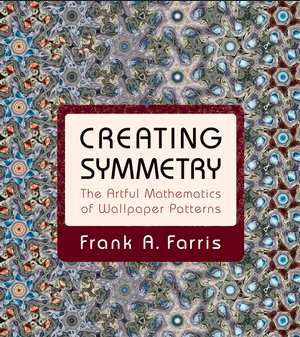
title: Creating Symmetry: The Artful Mathematics of Wallpaper Patterns Publisher: Princeton University Press Pages: 248 Year: 2015 ISBN: 9780691161730 (hbk) Price (tentative): GBP 24.95 (net) URL: press.princeton.edu/titles/10435.html Short description: A beautiful picture book, but containing a lot of mathematics that explains the reason for the frieze and wallpaper patterns that are shown. The mathematics are triggered by the artistic-creative process. Bull. BMS: ♠ MSC main category: 00 MSC category: 00A66 Other MSC categories: 20B30, 20H15, 20-01 |
|
Review:
At first glance one would expect here a coffee-table book with essentially beautiful pictures. The colorful pictures are certainly abundantly present, but the accompanying text is about serious mathematics. Farris starts with nice epicycloid-like curves generated by three (not two) circles. In complex notation, the curve is described by a sum of three complex exponentials. This immediately opens the bridge to groups (to make the curve periodic) and to Fourier series. Next the analogy of periodicity on the circle and periodicity along the line with period 2π is immediate and that leads to the combination of groups to generate the seven frieze patterns, and by mapping the upper half plane to the unit disk, this results in rosettes. Add to this the possibility of playing with color patterns and you get already a lot of possibilities to create nice pictures. With an extension to periodicity in different directions, we get lattices and arrive at the seventeen wallpaper patterns. Meanwhile one learns how to link symmetry with eigenvalue problems, waves defined on lattices, and the point group. Although 3D symmetry is not really the subject, it is possible by stereographic projection to catch some of the polyhedra symmetry in a planar picture. It is an easy step from stereographic projection to hyperbolic geometry which is the next design pattern used, both in the half plane and the disk. This, and also the previous patterns, reminds one of the artwork of M.C. Escher. As a tribute to Escher, the last chapter adds morphing to the wallpaper patterns which is here a simple matter of linear interpolation.
This is a marvelous book that brings groups, and along the way many other mathematical concepts, to the reader in a rather unconventional way. Rather than the axiomatic approach, the concepts are introduced as the creativity to design the patterns requires it. It is rather specific for the application in mind, but it is very stimulating as a first contact to abstract algebra. There are many exercises (literally in the margin) labeled with an order of difficulty. There is only one drawback. Although there is a chapter on the C++ code that Farris used to produce his pictures, he does not consider it polished enough to make it available to a broad public. A hands-on accompanying software tool would have made this exploration of symmetries so much more exciting.
Reviewer: A. Bultheel (KU Leuven)
September 9, 2015