|
Author(s): Mark I. Krusemeyer, George T. Gilbert and Loren C. Larson
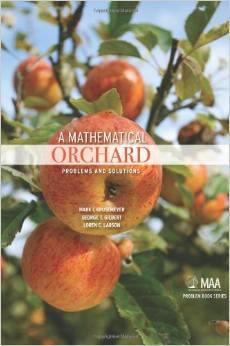
title: A Mathematical Orchard. Problems and Solutions Publisher: MAA Pages: xi+397 Year: 2015 ISBN: 978-0-88385-833-2 (pbk) URL: www.maa.org/publications/books/a-mathematical-orchard-problems-and-solutions Short description: This is a considerably extended version of a similar mathematical problem book that the MAA published in 1993. It contains challenging problems and more importantly detailed solutions to them, often more than one. Bull. BMS: vol. 24(3) p. 477-478, 2017 MSC main category: 00 MSC category: 00A07 Other MSC categories: 97D50, 97U40 |
|
Review:
This is a collection of 208 mathematical problems that should be solvable at an undergraduate level. It extends The Wohascum County Problem Book of 1993. Knowledge of calculus suffices for most of them. Sometimes a bit of geometry or statistics is required and selden some abstract algebra. The first 20% of the book consists of the formulation of the problems, and the next 80% gives the solutions, often more than one solution is provided. However, the problems should not be underestimated. Some are quite hard and require considerable mathematical skill to solve, and very few are just routine. The proposed solutions are extensively described. The most elegant solutions will probably not be the first that one will come up with, but they are therefore quite instructive. The problems were designed for amusement in the first place. Tackling one problem every week seems to be a good cruising speed. But it is also an ideal source of inspiration when preparing for a contest like a Mathematical Olympiad or Putnam.
Finding the key idea is often half the solution. So it might help to have a look at the indexes where it is said what is needed in each of the problems, another index says which problems rely on specific tools like e.g., polynomials, or inequalities, or combinatorial geometry,... and on top of this, there is a subject index. Also, some of the solutions start with an `idea', which can also serve as a hint.
If you are at the appropriate level of mathematical education and you are up to some challenges or if you have some young people to train in mathematical problem solving, then this is an excellent starting point to look for inspiration.
Reviewer: A. Bultheel (KU Leuven)
June 23, 2015