|
Author(s): Bahman Kalantari
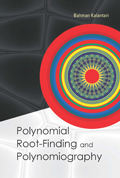
title: Polynomial root-finding and polynomiagraphy Publisher: World Scientific Pages: xxiii+467 Year: 2009 ISBN: 978-981-270-059-9 (hardcover) URL: www.worldscientific.com/worldscibooks/10.1142/6265 Short description: Coloring the basins of attraction of polynomial root finders condidered as dynamical systems gives nice pictures in the style of the fractal images related to Mandelbrot and Julia sets. Bull. BMS: vol 19(3) p.573-574, 2012 MSC main category: 12 MSC category: 12D15 |
|
Review:
Since Mandelbrot, everybody knows about the fractal art that was produced by plotting in colors the points in the complex plane that diverge to infinity, which is related to the analysis of Fatou and Julia sets for nonlinear dynamical systems. Dynamical systems and these fractal images has been a hype around 1990. This book is in the same style: coloring the basins of attraction for the roots of polynomials for certain iteration formulas gives similar colorful images as well (some of which are fractal). This visualization of the convergence of the root-finding iterations is coined polynomiography by this author who considers himself as much an artist as a mathematician/computer scientist. His main concern is a Basic Family of iteration functions defined as $B_m(z)=\theta+\sum_{k=m}^{m+n-2}\gamma_k(z)(z-\theta)^k$ where m ≥ 2 refers to the order of convergence (to θ), θ is a root of a polynomial p of degree n ≥ 2, and the γk are rational functions which should be chosen such that $B_m$ does not depend on &theta. The root to which convergence will occur depends on the basin of attraction that the starting point is taken in. These basins turn out to be the Voronoi regions of the θ to which one has convergence. For example if m = 2, then Newton's method is recovered. Several variants of this family are discussed as well (multipoint variations, truncated versions) and one can be computed from the other in a recursive way. The book is some round-up of publications of the author, but to me, it seemed like an erratic in some confusing way. There is some logic is the sequence of chapters, but I assume that the effort put in bringing them together has been minimal, or it may have some `artistic' flavor. Some are practically reprints of what has appeared already, so that they are almost readable independently, some have exercises at the end, others are short remarks (chap 6 has e.g. only 4 pages), some do not contain proofs and little mathematics, others are a minicourse on dynamical systems, and yet other are much more on the artistic side. Some deal with roots of polynomials, some with continued fractions and Padé approximation, others with approximations for π. So it is a patchwork of many nice and interesting things but in my opinion the patches are not so well stitched together. If you want to enjoy some of the nice pictures, you may always consult www.polynomiography.com or the author's website www.cs.rutgers.edu/~kalantar.
Reviewer: A. Bultheel (KU Leuven)
January 23, 2013