|
Author(s): Magdolna Hargittai, Isván Hargittai
title: Visual symmetry Publisher: World Scientific Pages: 224 Year: 2009 ISBN: 978-981-283-531-4 (softcover) URL: www.worldscientific.com/worldscibooks/10.1142/7042 Short description: Nice illustrations of many different forms of symmetries all around us. Bull. BMS: vol. 20(4) p.765, 2014 MSC main category: 52 MSC category: 52B15 |
|
Review:
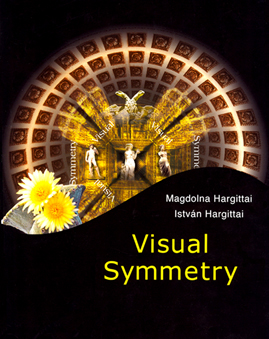
Symmetry has fascinated mankind since the origin of culture. So did it also strike these authors who have some mild form of ``symmetritis'' (viewing symmetry everywhere) since one or both were involved in some twenty published books in which symmetry played a central role. But, however fascinating it is, giving a precise definition of symmetry is not trivial at all. A mirror image is probably the first type that comes to mind, but there is so much more to it than that. Think of all the symmetry that can be found in the arabesques of the Alhambra or in the work of M.C. Escher. Moreover, the concept of symmetry has evolved over the centuries [See the review of ``From summetria to symmetry'', (G. Hon and B.R. Goldstein, Springer, 2008) in the Newsletter of the BMS/NCM, 2009, vol. 71.]. Rather than giving a precise mathematical definition, these authors (who are chemists and no mathematicians) just thought that a picture (and in this case actually some 650 pictures) is worth more than a thousand words. So they compiled a nice picture book that is most pleasing to look at. A book that you would give as a present, somewhat hesitating because you would like to keep it for yourself, if you didn't have it already. And you need not be a mathematician to be delighted by the beauty of the photographs. Most of them could have been taken by your own camera while on vacation which could be in Paris, Hawaii or your own back yard. The collection is ordered by the kind of symmetry that is considered (and ``symmetry'' is interpreted in the broadest possible form, which I would rather describe as ``structure''). And for each kind of symmetry, the pictures are grouped by topic. So there is mirror symmetry and chirality (like the left vs. the right hand), multiple symmetry (plane reflections and rotations) and just plain rotational symmetry, but also symmetry of polyhedra in 3D, repetitions (like e.g. colonnades), similarities (like matrushkas), spirals, plane filling patterns, and crystals structures. The subject can be almost anything like examples in flora or fauna, architecture, the human body, logos, snowflakes, etc. The texts with the illustration are minimal. Nevertheless, there are some interesting things to learn, like medicines with molecules having left chirality (the only one appearing naturally) can become very harmful when produced in a lab (because there both chiralities appear spontaneously), or the section with historical notes on the registration of snowflake forms, or the one on crystals etc. These are examples of reading pauses one could take while paging through the book. An ideal present to give, a desirable thingy to have in your library at home.
Reviewer: A. Bultheel (KU Leuven)
January 23, 2013