|
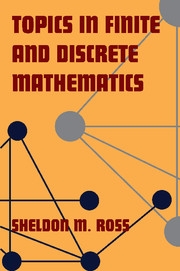
Author(s): Sheldon M. Ross
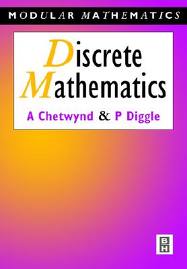
title: Topics in finite and discrete mathematics Publisher: Cambridge University Press Pages: ix+265 Year: 2000 ISBN: 0-521-7751-X (soft cover) URL: www.cambridge.org/be/knowledge/isbn/item1166362 Author(s): A. Chebwynd, P. Diggle title: Discrete mathematics Publisher: Arnold Pages: x+209 Year: 1995 ISBN: 0-340-61047-6 (soft cover) Author(s): Stephen B. Maurer, Anthony Ralston title: Discrete algorithmic mathematics (2nd ed.) Publisher: A K Peters Pages: xix+889 Year: 1998 ISBN: 1-56881-091-1 (hard cover) Short description: Bull. BMS: vol. 8(3) p.554, 2001 MSC main category: 68 MSC category: 68R99 Other MSC categories: 68-01 |
|

Review:
The first two of these books are very similar in contents and concept. With many examples and many exercises the basics of discrete mathematics are introduced. They both include the classical subjects: combinatorics, probability, graphs. Both are intended for first year students, although the book by Ross is at a slightly more advanced level. It also includes chapters on linear programming, mathematical finance (interest rates, options,...), statistics and group theory. On the other hand, the one by Chetwynd and Diggle has more pictures and has more introductory material like logic and techniques for proving theorems, set theory, and a chapter on relations and functions. Both are well suited as a course for informatics students, but they do not emphasize algorithmic aspects, so that they are equally well suited for any other curriculum where some elements of discrete mathematics are needed.
The third book by Maurer and Ralston is quite different in style and orientation. The title already highlights the algorithmic approach taken. So this is clearly aiming at informatics or computer science students. The topics discussed are comparable with what is in the other two books: combinatorics, graphs, and probability, but also difference equations, series, and linear algebra. All these subject are treated with a strong algorithmic component. Compared with the other two books (see the number of pages) this one is much more verbose. To give one example: mathematical induction is discussed on 3-4 pages in the first two books, while this notion takes more than 60 pages in the third.
In conclusion: The first book is best for the most mathematically oriented students, the second for the more applied students, and the last one is obviously for the informatics student.
Reviewer: A. Bultheel (KU Leuven)
January 26, 2013