|
Author(s): Frithiof Nevanlinna
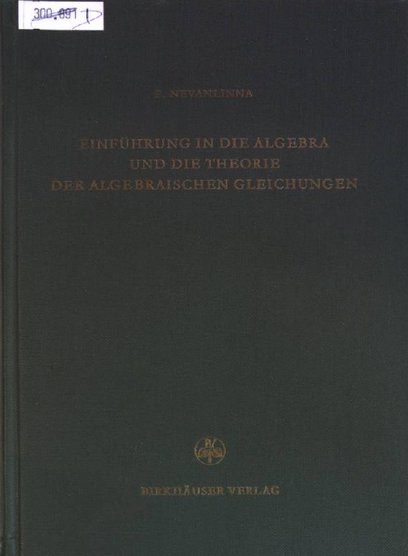
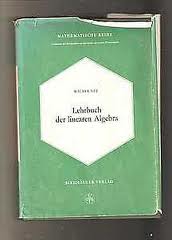
title: Einführung in die Algebra und die Theorie der algebraischen Gleichungen Series: Mathematische Reihe Publisher: Birkhäuser Verlag Pages: 218 Year: 1965 ISBN: 978-3764302757 Author(s): Walter Nef title: Lehrbuch der linearen Algebra Series: Mathematische Reihe, vol 31 Publisher: Birkhäuser Verlag Pages: 276 Year: 1966 URL: www.springer.com/book/ Author(s): Ladislaus Rédei title: Algebra, Erster Teil Series: Mathematik und ihre Anwendungen in Physik und Technik, vol 26 Publisher: Akademische Verlagsgesellschaft Geest & Pertig K.-G. Pages: xv+797 Year: 1959 Short description: Bull. BMS: ♠ MSC main category: MSC category: |
|
Review:
Three older German books on Algebra. The first two are from Birkhäuser's prestigeous series of textbooks Mathematische Reihe. Prestigeous because some of the best mathematicians have contributed to it and each volume is a high quality product, both in contents and in presentation. The series in which the third book appeared is not familiar to me, but this particular volume is at least of the same quality level as the other two books.
The first book by F. Nevanlinna is written to be useful as a textbook for an introductory algebra course. As the author writes in his preface, it should be a preparation for reading more advanced books like van der Waerden's Algebra. The selection of topics, made in Nevanlinna's book is somewhat old stylish. We find a discussion of the integers, groups, rings, and as the title indicates, a lot on equations and Galois theory. The presentation however is what makes the book interesting. It stays close to the historical evolution in algebra. The material is often treated twice~: once by ``classical'' methods and afterwards by ``modern'' group theoretical methods. This clearly shows how the abstraction in algebra is born. This is an invaluable insight which is often lost in modern approaches and this makes mathematics sometimes difficult for young students.
The second volume highlights another important aspect of algebra~: linear algebra. It is also written as a course book of a level comparable to the previous one and it is also easily recognized as a book written 25 years ago. It is neither very abstract nor is it very practical in the sense that it pays a lot of attention to the ``numerical'' or I should rather say ``calculus'' aspects. To make this point clear, I mention the fact that it doesn't only show how a system of equations can be solved in principle with the construction of a canonical form (for example the echelon form) but it says how to actually compute the result numerically by Gaussian elimination. However one knows that this method may be the simplest numerical method, but certainly not the best to use in actual computations. A similar remark holds for the applications (linear programming and some game theory), the ℓ2 and ℓ∞ solution of linear systems, eigenvalue decomposition and Jordan normal form. According to modern measures it is both theoretical, but not abstract and practical, but not numerically sound. It is what one would expect a course of this type to be when taught 25 years ago to engineers or applied mathematicians.
The last book is a bit older. It is the revised translation of the Hungarian original that was published in 1954 by Akadémiai Kiadó, Budapest. By its number of pages, you can see that it has to be much more substantial than the previous ones. Special attention is given to fields, division theory in a ring (not in a field), operator structures and modules, polynomial rings and Galois theory. One can see that the author has been inspired by van der Waerdens Algebra and Pickerts Einführung in die höhere Algebra. Almost a full account of Steinitz Algebraische Theorie der Körper is given. As in many German mathematics books, there is much text on a page which doesn't leave much blank space. There are 449 theorems in this thick volume numbered from 1 to 449. Therefore, it was a good idea to add on the odd numbered pages a footnote which says what theorems are found on the current two pages, or if there is none, then it indicates the next theorem to follow and how many pages it is ahead.
Three books which are certainly still valuable reference works, but yet you can't loose the feeling that they are a product of their time. Today, even if one would choose the same subjects, these books would be written differently.
Reviewer: A. Bultheel (KU Leuven)
January 23, 2013