|
Author(s): John Riodan
title: An introduction to Combinatorial Analysis Publisher: John-Wiley & Sons Pages: xi+244 Year: 1958 ISBN: 9780486425368 URL: mathdl.maa.org/mathDL/19/?pa=reviews&sa=viewBook&bookId=66853 Author(s): Jerome K. Percus title: Combinatorial Methods Series: Applied Mathematical Sciences, vol 4 Publisher: Springer Verlag Pages: 194 Year: 1971 ISBN: 978-0-387-90027-8 URL: www.springer.com/book/978-0-387-90027-8 Short description: Bull. BMS: ♠ MSC main category: MSC category: |
|
Review:
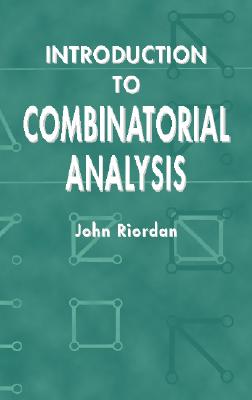
Of these three introductions to combinatorics, the first one is written with the highest ambition. It doesn't only introduce the reader to definitions, techniques and theorems, but also includes as much material as possible to make it a reference work. You will find for example several tables with formulas or numerical values. It certainly wants to give an up-to-date (in 1958 !) summary of what are the basic facts to be known to start off in combinatorics research. However, it is also a study-book. You can certainly learn about combinatorics for the first time from this book. All you need is a certain mathematical maturity. It starts from permutations, combinations and generating functions, and discusses further cycles in permutations, distributions, partitions, compositions, trees, networks and permutations with restricted position. The latter being original work by the author. There is an extensive set of exercises provided after each section.
The second book contains lecture notes of a course in combinatorial methods given by the author at the Courant Institute in 1967-68 before a heterogeneous group of students in mathematics, physics and chemistry. It is far less elaborated than the previous one and written for a more advanced and more applied audience. Permanents appear here on page 2 while they were never used in the previous book. The menage problem is found here on page 10, while it showed near the end (p. 195) of the previous book. Thus one could say that this book starts where the previous one ends. The book contains two chapters, 70 and 120 pages respectively. The first discusses counting and enumeration on a set, the second on a regular lattice. The main problems/theorems of the first chapter are the rencontre and the menage problem, the Master theorem, Ramsey's theorem and Polya's theorem appearing in a section on graphs. The second chapter is much more applied. It discusses random walk on lattices, the ballot problem, one dimensional lattice gas, the dimer and ice problems in two dimensional lattices with several solution methods, and the Ising model. A bibliography is not given, only a few references are given on the spot when a certain section is mainly covered in some particular paper.
The third book is the most simple one. It is written for first year university students (maybe with the exception of the last chapter on Steiner systems and sphere packing). After the introductory basic definitions, the author discusses pairing problems, optimal assignment problems, recurrence relations, the inclusion-exclusion principle and Rook polynomials as well as block designs with application in error-correcting codes. The text is extremely well written. Before an abstract mathematical definition is given, there is always a concrete example to introduce the topic, also between the formulation of the theorem and the proof one finds an example to check the theorem etc. There are also a lot of exercises which should keep the reader in pace with the development (solutions are provided in an appendix).
The three books show a certain evolution in the approach and applications of combinatorial methods. Since the last book appeared in 1974, discrete mathematics has certainly expanded considerably and for an up-to-date introduction, one should consult more recent works.
Reviewer: A. Bultheel (KU Leuven)
January 23, 2013