|
Author(s): Romantas Pupeikis, Kazys Kazlauskas
title: Advanced digital signal processin methods for filtering, identification, and nonlinear systems control Series: Studies in systems, decision and control, vol 638 Publisher: Springer Nature Year: 2026 ISBN: 978-3-032-06739-5 (hbk); 978-3-032-06742-5 (pbk; 978-3-032-06740-1 (ebk) Pages: xvi+163 pp. Price (tentative): € 148.39 (hbk); € 39.99 (pbk) (net) URL: link.springer.com/book/10.1007/978-3-032-06740-1 Short description: This is a collection of papers dealing with advanced topics in linear and nonlinear filtering and control problems. Published: MathSciNet MR5049695 MSC main category: 93 MSC category: 93-02 Other MSC categories: 93C10 93C40 93C62 93Exx 94A12 |
|
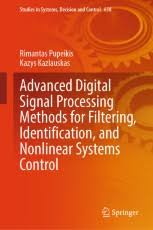
Review: This is a collection of papers discussing diverse advanced topics in systems, signals, and control. In the most general terms, these problems involve measuring the (noisy) input and output signal of a system (also called filter) representing a complicated (possibly nonlinear) transformation of the digital signal, and the problem is to identify or tune the unknown system, or to design a controller such that a desired output is obtained. Most often, a model is proposed and some parameters need to be estimated.
Chapter 1 is an overview, exploring the different topics covered in the next 8 chapters. Chapters 2 and 3 deal with filter design: adaptive least mean square (LMS) filters are obtained in an efficient way subdividing the data into blocks and using parallel processing on these blocks. The parametric identification of a periodic time-varying filter is also solved using a blocking strategy. By periodic subsampling, the data is again subdivided into blocks that can be processed in parallel. In Chapter 4 a procedure for the identification of autoregressive (AR) filters is discussed which has to iteratively improve, not only the filter coefficients, but also the autocorrelation and the variance of the noise.
The following chapters deal with different aspects of nonlinearities. Chapter 5 discusses nonlinearity of layered polynomial structures where the output depends not only on linear combinations of input samples, but also on quadratic terms or higher order products of the input samples. Layered versions of filters such as Volterra, polynomial AR, and bilinear filters are discussed. Each layer adds to the nonlinearity and can be easily implemented in an efficient way using MA (moving average) and AR filters. Chapter 6 deals with nonlinearity in a control problem trying to minimize a variance criterion for a stochastic ARMAX system. Block-oriented Wiener systems (a linear time-invariant block in series with a static non-linear block) or Hammerstein systems (the same two components in reverse order) are often used to simulate non-linearities, and in this case they are used to compute the controller. These two systems are further explored in chapter 7. When the non-linear part of the Wiener or Hammerstein system is piecewise linear, then partitioning the reordered data allows to identify the parameters of the system using ordinary least squares. Reordening of the data is also used in the next chapter for the identification of Wiener systems with a deadzone (i.e., there is an interval in the piecewise linear part with value zero). A final chapter gives numerical simulations for the minimum variance control of Wiener systems with a nonlinear part that is piecewise linear. Two appendices deal with consistent parameter estimation of Wiener systems and a list of examples where the methods of this book can be applied.
In each chapter the methods are illustrated with numerical examples as a proof of concept but there are no details about the software. All chapters conclude with a summary of its results and some references. Chapters are rather independent and need not be read in order.
Reviewer: A. Bultheel (KU Leuven)
© October 31, 2026