|
Author(s): Jin-Ho Park
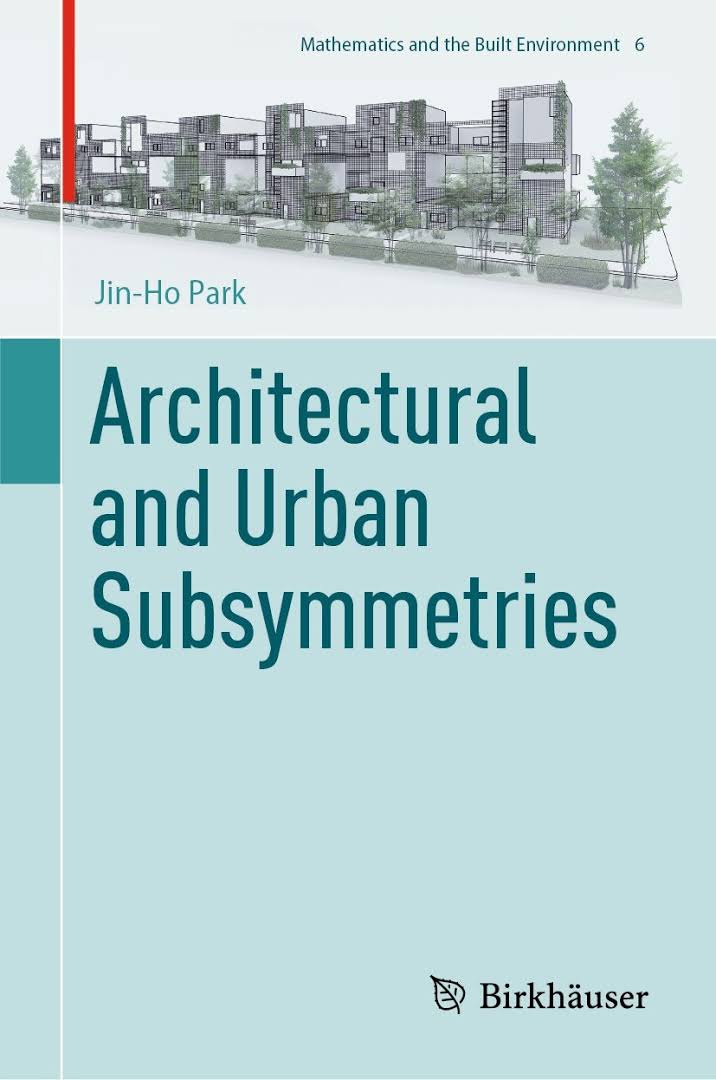
title: Architectural and urban subsymmetries Series: Mathematics and the Built Environment, vol.6 Publisher: Cham: Birkhäuser Year: 2022 ISBN: 978-3-031-08945-9 (hbk); 978-3-031-08946-6 (ebk) Pages: 266 pp. Price (tentative): EUR 148.39 (hbk); EUR 117.69 (ebk) (net) URL: link.springer.com/book/10.1007/978-3-031-08946-6 Short description: First symmetry groups (dihedral, frieze, and wallpaper groups), their subgroups and their Cayley diagrams are introduced. Then with real and hypothetical examples, it is shown how point symmetries are used in historical designs of buildings and cities, now considered dull, but how symmetry can also be used in modern real and hypothetical designs of buildings, city blocks, and cities without being dull. Published: zbMATH Open Zbl 07566642 MSC main category: 00 MSC category: 00A67 |
|
Review:
The book consists of two parts. In the first part the concept of symmetry group and its subgroups is explained, emphasizing their representation by Cayley diagrams, which is visually more appealing to non-mathematicians. The second part is larger and discusses the use of symmetry in architecture both in the design of buildings and in broader urban design.
First, point symmetry (dihedral groups $D_n$) is illustrated and discussed as it is used in the Pantheon in Rome and later in the design of fortified cities and in buildings (mostly Italian), the latter reaching a peak during the Renaissance.
Modern architecture also uses reflections and rotations on substructures but in a more subtle or complicated way which makes the result less boring. Examples from Frank Loyd Wright, Rudolf Michael Schindler, and Gregory Ain are discussed as well as some new possibilities to apply these modern ideas in individual buildings or city blocks.
Next, two chapters are devoted to illustrate the use of frieze and wallpaper groups (streets, housing clusters, stacked housing blocks, facades, cities). They involve realized and proposed projects, but also proposals for new, as yet unexplored possibilities that result from using the underlying mathematical properties.
In a final chapter the author lists 5 principles that have been illustrated that can be used to make new designs based on symmetries without resulting in a dull design.
Reviewer: A. Bultheel (KU Leuven)
© April 19, 2023