|
Author(s): R. Wilson, J.J. Watkins, D.J. Parks
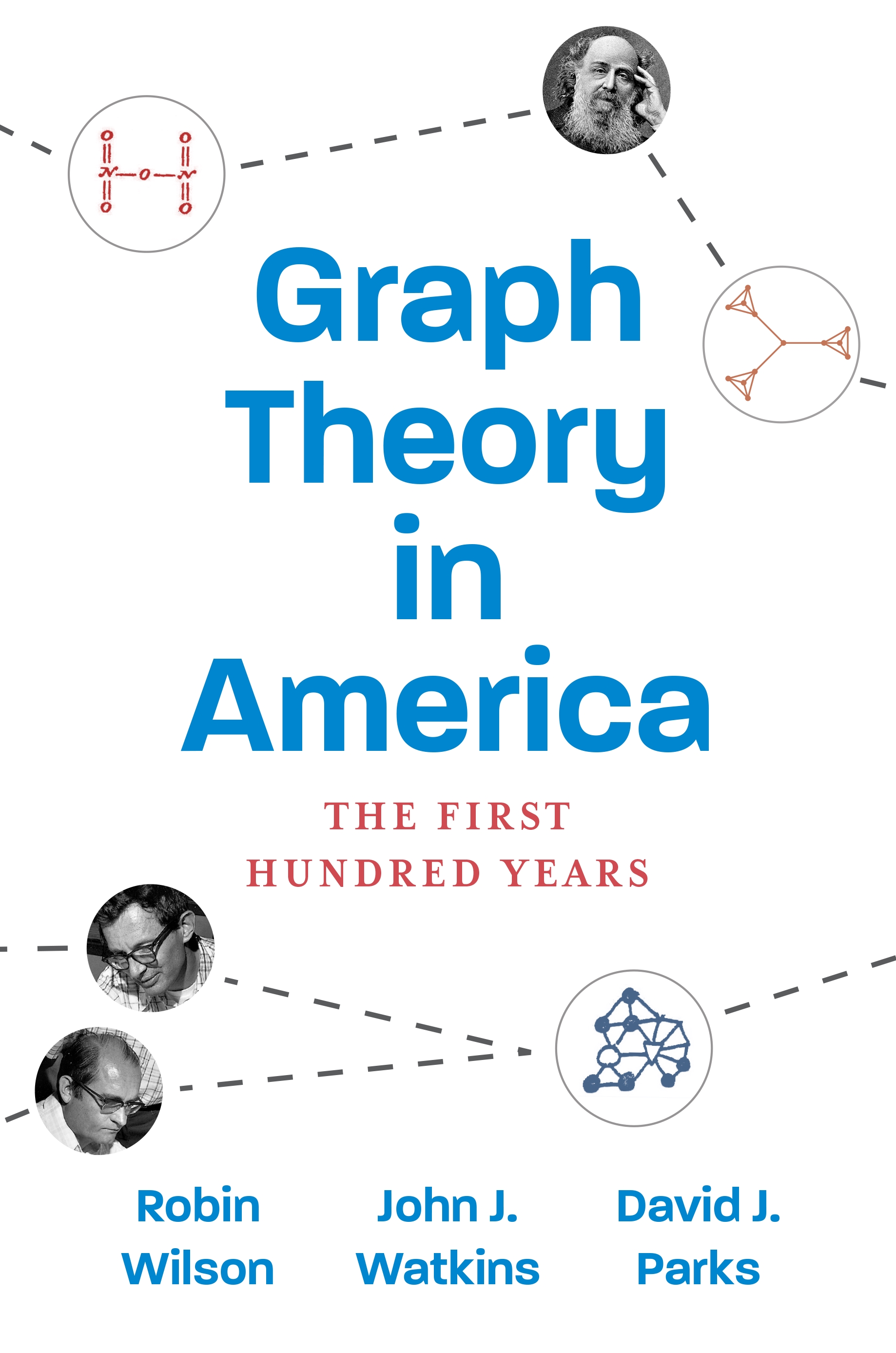
title: Graph theory in America. The first hundred years Publisher: Princeton University Press Year: 2023 ISBN: 9780691194028 (hbk); 9780691240657 (ebk) Pages: 320 pp. Price (tentative): USD USD 35.00 (hbk); USD 24.50 (ebk) (net) URL: press.princeton.edu/books/hardcover/9780691194028/graph-theory-in-america Short description: The authors describe how graph theory emerged in America essentially during the first hundred years. More precisely between 1876 when Sylvester started at the John Hopkins University and in his inaugural address stressed the relation between graphs and chemistry, and it ends with the proof of the four colour theorem by Appel and Haken in 1976. MSC main category: 05 MSC category: 05-02 Other MSC categories: 01A55 01A66 05-03 |
|
Review:
In this book, based on the PhD of the third author prepared under the supervision of the other two, the history is told of how graph theory started in America. The subtitle `The first hundred years' refers to approximately the period 1876 to 1976. In the starting year J.J. Sylvester was appointed at John Hopkins University. In his inaugural address, he stressed the connection between graphs and chemistry and introduced the word graph as we know it. And 1976 is the year that K. Appel and W. Haken eventually proved the four colour conjecture.
During the last decades of the 1800s one should realize that, unlike in Europe, research universities were relatively new in America. An introduction illustrates how Colleges gradually turned into Universities The main contributors for graph theory are besides Sylvester, A. Kempe, W. Story, and C.S. Peirce. The four colour conjecture (four colours suffice to colour any planar map such that no adjacent regions have the same colour) was often a source of inspiration to explore elements of graph theory. The vertices correspond to points where at least 3 different regions meet, and the boundaries connecting them can, without loss of generality, be represented by straight lines. The problem is to show that the chromatic number of this graph is at most 4. At some point Kempe published a proof of the four colour theorem, which turned out to be wrong. The subsequent chapters discuss the decades of the 1900s.
The history of the first decades is told by discussing the contributions of individuals. Their short biography and a picture is given and their other work for which they are often better known, is mentioned briefly, but the emphasis is on their contributions to graph theory. Between the chapters, some interludes discuss what is happening in parallel in Europe. There is of course exchange of people and ideas between America and Europe. So when in 1936 the first book on graph theory by D. König was published in German, the theory started developing quickly, and not only in Europe. So for this next decades, the authors group the discussion more around topics and the persons contributing to it rather than placing the persons central. The English translation of König's book did not appear until 1990. The first books on graph theory published in English were a book by C. Berge and one by O. Ore both published in 1962. Although the story of graph theory is told roughly in a chronological order, it may be very useful to regularly check an extensive chronological list of events in the beginning of the book. It is a rather detailed timeline starting in 1636 and ending in 2021.
It is not necessary to be familiar with graph theory to read about its history, but it will certainly help. A special feature of the book is that 18 important papers about graph theory are summarized in some inserts that can be skipped if so desired. But to give an example: it is explained how Kempe tried to prove the four colour problem and how it was flawed. There are also some formulas and mathematics in the main text, but that the emphasis is on the history and the people involved. For example there is no formal definition of the bipartite graph $K_{3,3}$ or the complete graph $K_3$ but it should be clear from the illustrations what they are, and there are many such illustrations to clarify the discussion. There is also a long glossary at the end where the keywords are explained in one or two sentences. The last chapter is completely devoted to the proof by Haken and Appel. Their search for unavoidable configurations (pieces of the map that have to appear) and reducible configurations (pieces of the map that are surrounded by a ring with a certain colouring, that are such that the colouring can be completed inside the ring). It left them with thousands of possibilities to check, which is where the programming skills of Appel comes in. Their proof became the first accepted computer assisted proof.
It is interesting also to learn something about the characters of the mathematicians, as far as it is documented. For example the raw between Sylvester and Kempe is analysed in some detail. Also the influence of the two World Wars on mathematics and mathematics is of course important. Some may be victim and others may have had antisemitic sympathies. In this timespan of one century we see how mathematics in America gets organized and becomes a partner at the level of the European community.
In this book, the four colour problem is rather dominant in the first decades and of course at the end when it was eventually solved. There are many other applications that came about while graph theory developed like logical and electrical circuits, recreational mathematics, crystallography, Ramsey theory and all the networks that interconnect our world today. Some of them are mentioned in the book but not as extensively. As computer became available around the middle of the 20th century, they were also applied to solve problems from graph theory. Since computational complexity is an important issue in combinatorial computation, also that is discussed by the authors, including the P≠NP problem. In a trailing section, called ``Aftermath'' other research topics of graph theory that were not mentioned before are briefly introduced.
To summarize: this is very informative and very readable book. It does not avoid some technical discussions, but not more than necessary. It has to be appreciated for what it is: the history of graph theory in America during the first 100 years. There are some small excursions to place everything in its proper historical context, but the history, and in particular the four colour problem, is the main concern of the authors. This means it is certainly not intended to be an introduction to graph theory or the mathematics involved and it not about theory and applications of contemporary graph theory.
Reviewer: A. Bultheel (KU Leuven)
© January 31, 2023