|
Author(s): [reviewed] Erica Thompson
title: Escape from model land Publisher: Basic Books Year: 2022 ISBN: 9781529364873 (hbk); 9781541600997 (ebk) Pages: 248 pp. Price (tentative): 20.00 GBP (hbk); 9781529364880 (pbk); 18.99 GBP (ebk) (net) URL: www.basicbooks.com/titles/erica-thompson/escape-from-model-land/9781541600980/ Short description: With many examples, the author illustrates the shortcomings of models as they are used to organize our daily lives. The examples are mainly models in finance, weather, climate, and pandemics . The defective and biased representation of our real world in model land should be handled with caution to make effective decisions for the real world.
This review was published in BMS/NCM Newsletter
|
|
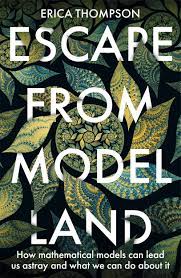
Review:
Much of our social life depends on models that simulate reality. Think of the financial market, the weather and climate models and de modelling of a pandemic. The main message of this book is that no matter how accurate the model is, what happens in the real world is not the same as what happens in Model Land. The general meaning of a model is that it is just a metaphor of reality.
There are so many pitfalls in which the model is believed to be reality that some warnings are necessary. This should allow the politicians, bankers, and anyone who has to make decisions on the basis of the models to `escape from model land' to make their decisions effective for the real world. There are obvious shortcomings like the simplification necessary in any model, the inaccuracy of the data on which it is built, but there is also the hidden bias of the beliefs of the designer or the purpose of the modelling that influences the model and its interpretation.i For a topologist, a donut is like a coffee cut but that does not work for a barista. Many models are WEIRD (Western, Educated, Rich, Developed), nut they do not apply in other circumstances. Data collected on fruit flies or mice, may not apply to mammals. Tests with only male test persons are not applicable for females. Big data models do not apply to small samples. The average person does not exist in the real world. Correlation is not the same as causality, probabilities may be conditional. And there are the models whose predictions may influence the outcome in the real world, something that is actively used in financial politics setting interest rates, or if banks take precautions because the model predicts a crisis, this may precipitate the crisis. Model predictions can be self-fulfilling prophesies. Most models may work reasonably well in a regime state of affairs, but there can always be some "black swan", i.e., some completely unexpected event that makes the model useless. On a less dramatic scale, a model based on data collected in the past may not be effective to predict the future. Elements that were not important in the past, and hence are not in the simplified model, may become important in the future due to a feedback loop. Other models are nonlinear and very sensitive to initial data resulting in chaotic behaviour like weather forecast can only be trusted on a relative short time scale.
These and many more pitfalls are amply illustrated in this text. Towards the end there are some more warnings. Models are the primary source for planning. Planning is necessary but the modus operandi must be flexible. It is always wise to have a plan B. Models also bing a problem of accountability. If decisions are made by politicians on the basis of a model, and it turns out to be the wrong decision, they can say that the model was not good. The designer of the model can say that the data were insufficient, or the purpose was not correctly specified, or the situation has changed, or the prediction was misinterpreted. Most models will suggest solutions on the basis of a minimal cost. But how is cost expressed? The politician has to find a difficult balance between economic and financial cost on one hand and the excess mortality on the other hand to decide about vaccination and lock-down.
In a concluding chapter, the author gives some practical advice for decision makers: Communication is important. What people believe or accept is often intuitive. Most people have never been in Model Land. Think outside the box. Be aware of, and do not restrict yourself to the limitations of the model to make a decision. Know that the model is made for. A model can only be accurate for what it has been designed for but totally inaccurate for another purpose. Allow flexibility and adaptability in the decisions you make in case reality deviates from the prediction of the model. Use several models to give different views of the real world. Even if a model is not good, it makes you think about the situation, so that you gain insight.
This book is obviously directed towards the modelling that is directly related to our daily life. It is not discussing the mathematics or the technical aspects of sampling and the physical, financial or biological laws that form the backbone of the models. With many examples it is illustrated for anyone without any mathematical, statistical or technical background what the limitations are and what can be decided on the basis of these models. The reader us brought to the verge of believing that all models are completely useless in our real word, but then she tempers that by illustrating why it is still useful to have models and how we can deal with all their deficiencies.
Reviewer: A. Bultheel (KU Leuven)
© November 22, 2024