|
Author(s): Dean G. Duffy
title: Advanced Engineering Mathematics: A second course Series: Advances in Applied Mathematics Publisher: CRC Press Year: 2022 ISBN: 9781032133423 (hbk); 9781003272205 (ebk) Pages: xvii+477 pp. Price (tentative): 59.99 GBP (net) URL: www.routledge.com/Advanced-Engineering-Mathematics-A-Second-Course-with-MatLab/Duffy/p/book/9781032133423 Short description: After several editions of the author's book Advanced Engineering Mathematics with MATLAB (see Zbl review) it was decided to split it into to parts. The most common subjects were collected under the same title (5th edition) and the more specialized ones form this volume. Published: zbMATH Open Zbl 7517348 MSC main category: 00 MSC category: 00A06 Other MSC categories: 44-01 60-01 |
|
Review:
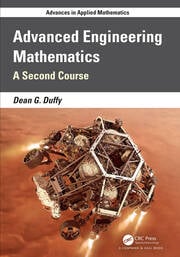
The author's book on Advanced Engineering Mathematics from 1998 became too voluminous to contain all the possible topics. After some experimentation with the arrangement of the different topics, it was decided to split it up in in two volumes. After examination of the curriculum at a number of institutes, the following division was decided. The first book [Duffy, Dean G. Advanced engineering mathematics with MATLAB. 5th edition. Advances in Applied Mathematics (Boca Raton). Boca Raton, FL: CRC Press (ISBN 978-0-367-62405-7/hbk; 978-1-003-10930-3/ebook). xix, 595 p. (2022; Zbl 1487.00002)] collects the subjects that appear most commonly in advanced engineering courses and can thus be produced in large quantities. In the other part, here under review, the topics are a bit more specialized. The successive chapters treat (1) complex functions, (2,3,4) Laplace, Fourier, z-, and Hilbert transforms, (5) Green's function, (6,7,8) probability, random processes, and It\^o's stochastic calculus. This gives essentially two parts: (1-5) aiming at students in electrical engineering and communication, while (6-8) points towards the increasing importance of stochastic models for physical systems.
Fourier and Laplace transforms appear also in the other volume, but here, use is made of the complex function theory developed in chapter 1, to invert these transforms and apply them to integral and partial differential equations. The second part with stochastic processes (Brownian motion, Poisson and birth and death processes) and stochastic differential equations are less traditional topics in this kind of courses.
The principles and ideas of previous editions are maintained. The book clearly aims at engineering students because the main focus is on solving problems. After motivating and defining the concept or technique, properties are obtained but hard proofs are avoided as much as possible. A few books are suggested for proofs and further reading. There are however many examples instead that make the result plausible, and, although it is not in the title, also this book includes at many places matlab code that can be used for experimentation. The main focus is on the use of the mathematical formulas that solve the problems, no special attention is paid to advanced numerical analysis that is needed for more real life problems. That should be discussed in a different course. Like any similar set of lecture notes, there are many exercises included. The answers to the odd numbered ones are listed at the end.
Reviewer: A. Bultheel (KU Leuven)
© August 6, 2022