|
Author(s): Jessica Wynne
title: Do not erase Publisher: Princeton University Press Year: 2021 ISBN: 9780691199221 (hbk); 9780691222820 (ebk) Pages: 240 pp. Price (tentative): USD 35.00 (hbk) (net) URL: press.princeton.edu/books/hardcover/9780691199221/do-not-erase Short description: This book is the result of an art project of the photographer Jessica Wynne who took pictures of blackboards written on with chalk by mathematical researchers from all over the world. A one-page text is accompanying every photograph in which the mathematician reflects on his or her work. Published: MAA Reviews here MSC main category: 01 MSC category: 01-00 |
|
Review:
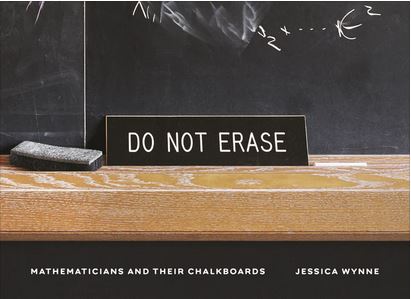
The legend goes that Archimedes exclaimed `Do not disturb my circles' addressing the soldier who was going to kill him. That referred to the circles he had drawn in the sand. Nowadays you can often read `Do not erase' on a blackboard full of formulas and drawings that are the result of a burst of solitary inspiration or of an intense dialogue between mathematicians trying to crack a problem.
The blackboard is still today an essential tool for mathematicians, especially those that do pure mathematics. Perhaps, applied mathematicians will be inclined sooner to use the computer and for lectures during conferences, a presentation is often electronic, given the limited time. However, for teaching or for explaining to a colleague where, deep down in the problem, there is something unclear or unanswered, a slow development of ideas while writing in a structured way on a blackboard is a preferred alternative. The scribbled-on blackboards that are the result of a freewheeling stream of consciousness during a discussion between researchers is often much less structured, with erasure stains and formulas written over them. Most of the pictures in this book are of the latter type.
Jessica Wynne is a photographer who got interested in the special relation that mathematicians seem to have with chalk and blackboard. She sees it as a visualisation of the creativity process that is perhaps only accessible for insiders, but it is still a piece of art, reflecting some of the beauty of mathematics that, especially pure mathematicians, are trying to disclose. When looking at the blackboard as a canvas, it is like a painting, and it is not necessary to understand the mathematics behind or all the symbols to appreciate its intrinsic beauty.
In this art project Jessica Wynne has travelled all over the world visiting research institutes and universities where she met the mathematicians and their blackboards. The condition was that it was a true blackboard written on with chalk and not a shiny whiteboard written on with smelly markers. Some of the boards were already filled, others were especially prepared for the picture. She seems to have easily found over a hundred mathematicians to contribute to her project. The book is the physical result. It has 240 pages in landscape format (11.18 x 8.27 inches). Two pages are devoted to each mathematician. This is of course the photograph of the blackboard, on the right page, accompanied by a text page from the mathematician on the left page. The text contains besides a very short identification of the mathematician in the margin, a short essay that the mathematicians were supposed to write with often some thoughts about their research and/or their preference for using the blackboard. There are many different research subjects and many different mathematicians, hence these text contributions are very diverse, but always enlightening, and disclosing some of the world that mathematicians are wandering around in when working. Most pictures are a very typical collection of random formulas with an occasional graph, but some mathematicians took the task quite literally and produced a painting with chalk. Sometimes it are nice complicated drawings possibly with coloured chalk, some are quite sober schemes. Tadashie Tokieda literally made a chalk painting referring, tongue in cheek, to Margritte's `Çeci n'est pas une pipe' by drawing an empty and a filled small circle in white chalk and with the text `ceci est un point NOIR' with an arrow pointing to the filled one and for the empty one the text `BLANC'.
This is a wonderful mirror that Jessica Wynne shows us mathematicians of a world that is so very familiar when looking at it from the inside of our world of mathematics. It has inspired the contributing mathematicians to do some reflection on their work, but similarly, we as a spectator are looking at our own world through the eyes and the camera window of an outsider. This also forces us to think in a different way about what we are doing day in and day out.
Reviewer: A. Bultheel (KU Leuven)
© August 2, 2021