|
Author(s): R. Snieder
title: A guided tour of mathematical methods for the physical sciences Publisher: Cambridge University Press Year: 2001 ISBN: 0-521-78751-3 Pages: 429 pp. Short description: Published: ITW-Nieuws (Werkgroep Industriële en Toegepaste Wiskunde) MSC main category: MSC category: |
|
Review:
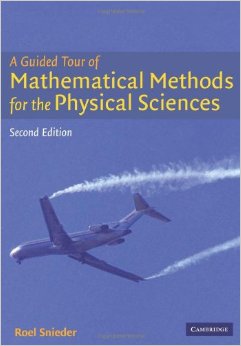
Allerlei wiskundige begrippen en technieken gebruikt in de natuurkunde komen aan bod: van Taylor- en Fourierreeksen over vectorrekening en lineaire algebra tot potentiaaltheorie en tensorrekening. De wiskunde is geheel ondergeschikt aan de natuurkunde en de relevantie wordt geïllustreerd met een schat aan interessante fysische problemen. In plaats van afleidingen en bewijzen te geven wordt de lezer door het oplossen van een opeenvolging van deelprobleempjes naar het resultaat geleid. Een voorafgaande cursus analyse en lineaire algebra is wel nodig. Het boek is in de eerste plaats voor studenten natuurkunde bedoeld. Het is voor hen bruikbaar als cursusboek wiskundige natuurkunde. Studenten en docenten wiskunde vinden hier zeer veel inspiratie ter illustratie van wiskundige begrippen. Vooral studenten van een technische (ingenieurs)richting zullen dit appreciëren.
Many mathematical notions and techniques used in physics are considered: from Taylor and Fourier series over vector calculus and linear algebra to potential theory and tensors. The mathematics are subordinate to the physics and the relavance is illustrated with a treasure trove of interesting physical problems. Instead of giving derivations and proofs, the reader is guided towards the result by solving a sequence of subproblems. A first course in analysis and linear algebra is a prerequisite. The book is intended for physics students in the first place. For them it can be used as lecture notes for a mathematical physics course. Mathematics students and teachers, can find here a lot of inspiration to illustrate their mathematics. Most of all technical (engineering) students will appreciate this.
Reviewer: A. Bultheel (KU Leuven)
© June 11, 2015