|
Author(s): Rodney A, Kennedy and Parastoo Sadeghi
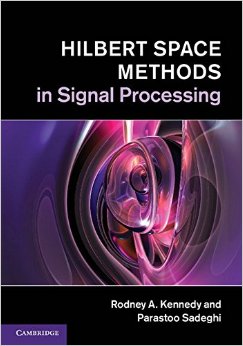
title: Hilbert space methods in signal processing Publisher: Cambridge University Press Year: 2013 ISBN: 978-1-107-01003-1 Pages: xviii+420 pp. Short description: The book is to provide the mathematical tools for advanced engineering students who want to engage in signal processing problems on the 2-sphere. Published: MathSciNet MR3052450 MSC main category: 94 MSC category: 94-01 Other MSC categories: 42B10 46-02 47B32 65Jxx 94A12 |
|
Review:
The goal of this book is to provide the mathematical tools for advanced engineering students who want to engage in signal processing problems on the 2-sphere. These have applications in e.g., cosmology, computer graphics, and communication. This is considerably different from signal processing on Euclidean domains like audio signals or images. These signal processing tools are discussed in part 3, which takes the second half the book. It deals among many other issues with spherical harmonics, time-frequency concentration, convolution, and reproducing kernel Hilbert spaces. The authors confine themselves to the mathematical analysis. The practical applications or the concrete numerical implementations are not included. The first half of the book serves to introduce all the basics needed from Hilbert spaces (part 1) and operators (part 2).
Being written for engineering students, insight prevails sometimes over a strict formal mathematical proof. New concepts are introduced gradually and never without a motivation. The style is lively, and the mathematics are interrupted by historical remarks and anecdotes about the main mathematicians (depicted in cartoons) who developed the theory. Sections end with `take-home messages', i.e, the things to be remembered. Problems are scattered throughout the text with answers given at the end of the book.
Although written as a gentle introduction for engineering students, the mathematics are thourough. One of the first sections on infinity and transfinite numbers may discourage some readers, but it all blends in nicely. Even in the first two parts, which are basic, some insights are given that can be enlightening for professionals as well.
Reviewer: A. Bultheel (KU Leuven)
© June 11, 2015