|
Author(s): Are Hjørungnes
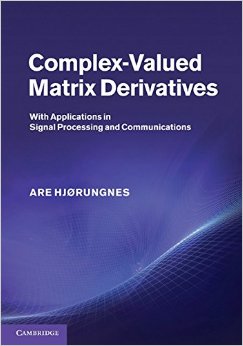
title: Complex-valued matrix derivatives. With applications in signal processing and communications Publisher: Cambridge University Press Year: 2011 ISBN: 978-0-521-19264-4 Pages: xxii+247 pp. Short description: This is a self-contained engineering approach to the study of derivatives of matrix-valued functions with respect to matrix variables. Published: MathSciNet MR2796942 MSC main category: 30 MSC category: 30G30 Other MSC categories: 15-01 94-01 94A12 |
|
Review:
This is a self-contained engineering approach to the study of derivatives of matrix-valued functions with respect to matrix variables. Vectors and scalars are special cases of matrices, but for didactical reasons the concepts are introduced first for scalars, then vectors, then matrices. In this book, the matrix elements are considered mainly to be complex, while in a similar book [J. R. Magnus and H. Neudecker, Matrix differential calculus with applications in statistics and econometrics, Wiley Ser. Probab. Math. Statist. Appl. Probab. Statist., Wiley, Chichester, 1988; MR0940471 (89g:15001)] the real-valued case was considered. Also the optimization applications are different. Here they stem from signal processing and communication rather than from probability and statistics.
There are two main tricks used to introduce these derivatives in a uniform way. The first is to "vectorize'' matrices (i.e., to transform them into long vectors containing the matrix elements) and to manipulate them using Kronecker and Hadamard products. This is the main subject of chapter 2. The second trick is to consider the function as depending on two independent parameters: $z$ and its complex conjugate $z^*$ (whether these are scalars, vectors or matrices). The approach is based on differentials instead of elementwise derivatives. This general idea is the subject of chapter 3, while in chapter 4 it is worked out first for scalar-valued functions depending on scalar, vector, and matrix variables, which is then subsequently repeated for vector-valued and matrix-valued functions. In a similar way, second-order derivatives (Hessians) are discussed in chapter 5: first scalar-valued, then vector-valued and then matrix-valued functions, all depending on matrix variables.
In some applications the matrices may have some "pattern'' (e.g. symmetry), in which case the matrix elements are not independent. This pattern can be described by a "parameterization function''. The derivative of functions with respect to matrices having some pattern are called "generalized derivatives''. If the parameterization function is a diffeomorphism and the patterned matrices belong to a manifold, a theory is developed based on the chain rule and several examples are worked out in more detail (diagonal, (skew-)symmetric/Hermitian, orthogonal/unitary, positive semidefinite). The final chapter illustrates the theory with several examples from signal processing and communication. Each chapter has some exercises. No solutions are provided in the book, but a manual is available on the Web.
Reviewer: A. Bultheel (KU Leuven)
© June 11, 2015