|
Author(s): J. M. Combes, A. Grossmann and Ph. Tchamitchian (eds.)
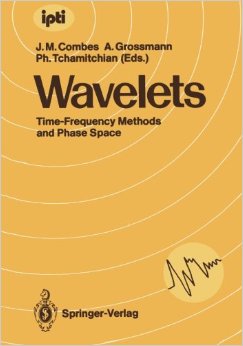
title: Wavelets. Time-frequency methods and phase space Series: Inverse Problems and Theoretical Imaging Publisher: Springer-Verlag Year: 1989 ISBN: 3-540-51159-8 Pages: x+315 pp. Short description: This book forms the proceedings of an interdisciplinary meeting of people using these methods. Topics discussed range from purely mathematical over signal processing (speech, seismic, acoustic, computer vision) to numerical implementations of the transform. Published: MathSciNet MR1010895 MSC main category: 42 MSC category: 42C15 Other MSC categories: 42-06 94-06 |
|
Review:
Contents: A. Grossmann, R. Kronland-Martinet and J. Morlet, Reading and understanding continuous wavelet transforms (pp. 2–20); Y. Meyer, Orthonormal wavelets (pp. 21–37); I. Daubechies, Orthonormal bases of wavelets with finite support—connection with discrete filters (pp. 38–66); P. Flandrin, Some aspects of nonstationary signal processing with emphasis on time-frequency and time-scale methods (pp. 68–98); M. Basseville, Detection of abrupt changes in signal processing (pp. 99–101); J.-C. Risset, The computer, music, and sound models (pp. 102–123); J. L. Larsonneur and J. Morlet, Wavelets and seismic interpretation (pp. 126–131); F. B. Tuteur, Wavelet transformations in signal detection (pp. 132–138); S. Ginette, A. Grossmann and Ph. Tchamitchian, Use of wavelet transforms in the study of propagation of transient acoustic signals across a plane interface between two homogeneous media (pp. 139–146); J. P. Sessarego, J. Sageloli, P. Flandrin and M. Zakharia, Time-frequency analysis of signals related to scattering problems in acoustics. I. Wigner-Ville analysis of echoes scattered by a spherical shell (pp. 147–153).
J. G. Slama, Coherence and projectors in acoustics (pp. 154–157); J. S. Liénard and C. d'Alessandro, Wavelets and granular analysis of speech (pp. 158–163); J. Bertrand [Jacqueline Bertrand] and P. Bertrand, Time-frequency representations of broad-band signals (pp. 164–171); A. Berthon, Operator groups and ambiguity functions in signal processing (pp. 172–180); A. Arneodo, G. Grasseau and M. Holschneider, Wavelet transform analysis of invariant measures of some dynamical systems (pp. 182–196); J. Bros, Holomorphic integral representations for the solutions of the Helmholtz equation (pp. 197–203); T. Paul, Wavelets and path integral (pp. 204–208); K. Seip, Mean value theorems and concentration operators in Bargmann and Bergman space (pp. 209–215); G. Bohnke, Besov Sobolev algebras of symbols (pp. 216–220); J.-P. Antoine, Poincaré coherent states and relativistic phase space analysis (pp. 221–231).
J. Bertrand [Jacqueline Bertrand] and P. Bertrand, A relativistic Wigner function affiliated with the Weyl-Poincaré group (pp. 232–238); R. Murenzi, Wavelet transforms associated to the n-dimensional Euclidean group with dilations: signal in more than one dimension (pp. 239–246); S. Jaffard, Construction of wavelets on open sets (pp. 247–252); P. Auscher, Wavelets on chord-arc curves (pp. 253–258); R. R. Coifman, Multiresolution analysis in nonhomogeneous media (pp. 259–262); Ph. Tchamitchian, About wavelets and elliptic operators (pp. 263–268); V. Perrier, Towards a method for solving partial differential equations using wavelet bases (pp. 269–283); M. Holschneider, R. Kronland-Martinet, J. Morlet and Ph. Tchamitchian, A real-time algorithm for signal analysis with the help of the wavelet transform (pp. 286–297); P. Dutilleux, An implementation of the "algorithme à trous'' to compute the wavelet transform (pp. 298–304); P. Hanusse, An algorithm for fast imaging of wavelet transforms (pp. 305–312).
Time-frequency and phase space methods are well known but wavelets form a relatively new tool in function (= signal) analysis. A wavelet transform of a signal s(t) is defined as (bar means complex conjugate) $S(a,b)=a^{−1/2}\int\overline{g}((t−b)/b)s(t)dt$, where $g(t)$ is the analysing wavelet and $w_{a,b}(t)=a^{−1/2}g((t−b)/a)$ form the rest of the family of wavelets. Equivalently, this transform can be written in terms of Fourier transforms $\hat{g}$ and $\hat{s}$ as $S(a,b)=a^{1/2}\int\overline{\hat{g}}(a\omega)\exp(ib\omega)\hat{s}(\omega)d\omega$. The parameter $a$ indicates the scale and $b$ is the time parameter. Thus the use of wavelets results in a time-scale method. Usually, besides others properties like integrability, etc., $g(t)$ should be smooth and have concentrated support in the time and frequency domains, the Gauss function being a typical example. There are some indications that the human mind analyses acoustic or visual signals in a "wavelet fashion''.
This book forms the proceedings of an interdisciplinary meeting of people using these methods. Topics discussed range from purely mathematical over signal processing (speech, seismic, acoustic, computer vision) to numerical implementations of the transform.
The papers are divided into five parts. The first three papers give different approaches to the wavelet concept, the second being the most mathematical, but all three are rather descriptive. Together they form a good introduction to the subject. The next three papers form the second part, dealing with some topics in signal analysis. The contribution by Basseville is only an abstract plus references. The contents of the other two papers are described accurately by their titles. Part Three consists of the next eight papers, all of them relatively short and all treating different aspects of the three topics of the title of this book in relation with signal processing. Several are concerned with specific applications. Part Four groups thirteen papers with a common interest in mathematics and/or mathematical physics. Among these one finds several generalizations of the classical wavelets. Also, group-theoretic foundations for wavelet analysis and the use of wavelets as a basis to describe the solutions of functional equations are discussed. The last three papers deal with the numerical implementations: the real time analysis of signals, the wavelet transform evaluated on a digital filter and the visual representation of these transforms. This book contains several color illustrations of such representations.
With few exceptions, most of the authors are French or work at a French institute.
Reviewer: A. Bultheel (KU Leuven)
© June 11, 2015