|
Author(s): A. Gil, J. Segura, N.M. Temme
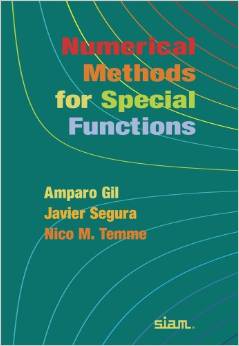
title: Numerical methods for special functions Publisher: SIAM Year: 2007 ISBN: 978 0 898716 34 4 Pages: xiv+417 pp. Short description: Description and analysis of numerical methods for computing and approximating special functions. Published: J. Approx. Th. 162 (2010) 872-874 MSC main category: 65 MSC category: 65D20 Other MSC categories: 33-00 |
|
Review:
Although there is no strict definition of a ``special function'' it is generally understood which subset of the mathematical functions are considered ``special''. The authors define them as those functions which are widely used in scientific computing and technical applications, and of which many useful properties are known. These functions feature in all kinds of problems in applied mathematics, statistics, physics and engineering. Sometimes they help to find a numerical solution, sometimes they give a closed form solution or help to derive properties (e.g. asymptotic behavior) of the solution.
Obviously when reading the title, a mental link with the classical Handbook of mathematical functions by Abramowitz and Stegun [1], or with the digital version [6] will be made spontaneously. Unlike the original Handbook, that had a lot of tables, in more recent versions and in many other books that appeared since then, the tables were replaced by algorithms and software that computes the numbers on the fly whenever they are needed.
This book does not only describe the software for computing a set of special functions, nor do the authors claim to provide all that is needed to compute each and every special function. It gives a relatively broad view on the numerical methods and the necessary analytical background, needed to deal with these functions in all the applied problems where they are needed. In the words of the authors: it is their main purpose to describe methods ... which, according to our own experience, appear most frequently in the computation of special functions. Consequently, it looks at first sight more like a course in numerical analysis, although with strong focus on special functions. Their hope is that it will be of interest to a broader numerical audience, than just the special functions community. In fact, parts of the book are well suited to be included as case studies in a general advanced numerical analysis course.
There are four distinct parts in the book. The first part describes the truly basic methods, which include convergent and divergent series, Chebyshev expansions, recurrence relations and quadrature formulas. The choice of these topics illustrates the focus of the book on special functions, but at the same time, each of these topics have a general interest and are relevant in problems quite remote from special functions too. This part also starts by making the link with differential equations. An approximate solution, possibly around a singular point, is often obtained using a series expansions, and in many courses, this is where special functions show up for the first time. Special functions and differential equations live like birds of a feather: one helps computing and understanding properties of the other. Therefore differential equations pop up now and then throughout the book. Of course the topics in this part are related: (three term) recurrence relations, continued fractions, orthogonal polynomials, numerical (Gauss) quadrature etc. are all part of a well known circle of ideas. Somewhat less expected is that the quadrature part does not only treat the usual rules for one-dimensional real integration, but also contour integration in the complex plane. The treatment in the first part is, like in the whole book, easy-reading, emphasizing the practical aspects and avoiding too much formal theory with only few essential proofs explicitly included.
The second part adds more tools, which are somewhat more specialized, well known by the ``special functions in-crowd'', but not as generally used by the ``broader audience''. It contains more methods that are especially useful when applied to particular special functions. A first chapter deals with continued fractions (numerical evaluation, convergence domains, expansions for some special functions). Some less known evaluation methods, originally designed for special functions turn out to be useful for general evaluation of continued fractions. A second chapter treats the computation of zeros of special functions. Any general method can be applied of course, but knowledge of the approximate location of the zeros is sometimes necessary for convergence. Asymptotic expansions are an essential tool here, but this is also one of the rare instances in this book where linear algebra plays a role (when zeros are characterized as eigenvalues of a matrix). Uniform asymptotic expansions, discussed in the next chapter are important to cope with rapidly changing behavior like Airy functions or Bessel functions (from highly oscillating to exponentially decaying) or the incomplete gamma function (with a steep transition from zero to one). These two examples are treated in detail with quite impressive results. The final chapter of this part discusses miscellaneous techniques like Padé approximation, sequence transformations, best rational approximation, Taylor series methods for differential equations, and more advanced quadrature methods.
The first two parts form the larger part of the book. Part three is much more specialized, treating specific examples like the (asymptotic) inversion of distribution functions, in particular gamma and beta distributions, and various topics like Euler summation, computation of symmetric elliptic integrals and numerical inversion of the Laplace transform.
The fourth and final part describes specific algorithms that implement the methods described previously. The Fortran software can be downloaded from functions.unican.es where for the moment one can find the code of some of the items of the Collected Algorithms of the ACM (described in Transactions on Mathematical Software) and links to algorithms published in Computer Physics Communications Program Library (described in Computer Physics Communications) by Elsevier. The site will be updated as new or updated software becomes available. Also corrections to the printed version are posted there. Of course there is a lot of other software available for which references are given.
To summarize we can say that this book is a rather broad approach to a specialized topic. There is a multitude of topics that is discussed, and one can not expect that each of these is treated in detail. For example, on Padé approximation and continued fractions alone, many books have appeared, sometimes having a chapter or chapters devoted to special functions [3-5] and there are numerous books devoted to special functions e.g. [2] but usually leaving the numerical aspects aside. Of course, a lot has changed since the third author published [7] (a reference that is for some reason not mentioned in the otherwise quite extensive list of references), so that an update is certainly welcome. Because of the cascading from general to more specific as one steps from one part to the next, the reader may be somewhat confused and get the impression that he is wading through an ocean of techniques which finally result in specific methods for specific functions. But that is a choice made by the authors: to keep their methods as broad as possible, but when it comes down to a practical example, one has to give up on generality and the available methods for each problem are indeed quite diverse. It is certainly a must-have book for researchers doing the actual computations involving special functions, but they should preferably have had some separate numerical training. Subtitles like ``for the impatient'' or ``for dummies'' does certainly not apply in this case. For the general numerical analyst, it contains very interesting case studies and applications.
References
- M. Abramowitz, I. Stegun, Handbook of Mathematical Functions, Dover Publications, New York, 1968.
- G.E. Andrews, R. Askey, R. Roy. Special Functions, in: Encyclopedia of Mathematics and its Applications, vol. 71 Cambridge University Press, Cambridge, UK, 1999.
- G.A. Baker, Jr., P.R. Graves-Morris, Padé Approximants, in: Encyclopedia of Mathematics and its Applications, vol. 59, Cambridge University Press, 2nd edition, 1996.
- A. Cuyt, V. Petersen, B. Verdonk, H. Waadeland, W.B. Jones, Handbook of Continued Fractions for Special Functions, Springer Verlag, 2008.
- L. Lorentzen and H. Waadeland, Continued Fractions, Vol. 1: Convergence Theory, in: Atlantis Studies in Mathematics for Engineering and Science, vol. 1, World Scientific, 2008. second edition.
- National Institute of Standards and Technology, Digital Library of Mathematical Functions, 2009. http://dlmf.nist.gov/ . Soon to be published by Oxford University Press together with the first official release of the website.
- C.G. van der Laan, N. Temme. Calculation of Special Functions: The Gamma Function, The Exponential Integrals and Error-Like Functions, in: CWI tract CWI, vol. 10, 1984.
Reviewer: A. Bultheel (KU Leuven)
© June 11, 2015