|
Author(s): C.T. Kelley
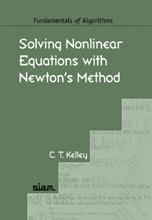
title: Solving nonlinear equations with Newton's method Publisher: SIAM Year: 2003 ISBN: 0-89871-546-6 Pages: 104 pp. Short description: A short monograph that gives the state-of-the-art of numerical algorithms including sufficient theoretical background to understand the methods, but also details on implementation, and their limitation, a guideline on how to choose a method for this particular problem and how to deal with failures. Published: Math. Comp. MSC main category: 65 MSC category: 65H05 Other MSC categories: 65H10 65F10 65F22 |
|
Review:
In the new series Fundamentals of algorithms, SIAM wants to publish short monographs that give the state-of-the-art of numerical algorithms including sufficient theoretical background to understand the methods, but also details on implementation, and their limitations, a guideline on how to choose a method for a particular problem and how to deal with failures.
This first volume deals with Newton's method for the solution of nonlinear equations and systems of nonlinear equations. It perfectly fits the objectives of the series. A book like Kelley's Iterative methods for solving linear and nonlinear equations (SIAM, 1995) places its contents in a broader perspective.
The nice thing about this book is that it builds up the practical algorithms progressively just as a numerical analyst would design it. One starts with an elementary implementation, test it and discovers some shortcomings, find a remedy for them, which leads to an improved version etc. All the aspects are dealt with: adequate selection of starting vectors, efficient computation of the update steps, stopping criterion, convergence analysis, memory and time efficiency, and, not to forget, the human time, i.e., the time needed to find an appropriate algorithm for your problem if you do not want to write the algorithm yourself. All these topics appear already in the first introductory chapter, mostly illustrated in the scalar case.
When one is dealing with systems of equations, then the update step involves the computation of the approximate Jacobian and the solution of a linear system. So, a considerable part of the text deals with efficient computation of approximate Jacobians and with the (iterative) solution of (large sparse) linear systems. While chapter 2 deals with direct solvers for the linear system, chapter 3 treats Newton-Krylov methods using the iterative solvers GMRES, BiCGSTAB, and TFQMR and the final chapter 4 discusses quasi-Newton methods represented by Broyden's update of the Jacobian. Besides the examples that are worked out with the different methods (Chendrasekhar's H-equation, two-point boundary value problem, Ornstein-Zernike equation, convection-diffusion equation), also some suggestions for stimulating projects are given at the end of the chapters.
The algorithms are given in pseudo-code and in matlab code which allow the reader to experiment with the methods on some simple, but also on some less trivial examples. Of course the code need not be typed because it can also be downloaded from www.siam.org/books/fa01.
The book contains a wealth of hints for improving efficiency, and performance, it gives many enlightening explanations of what can go wrong and how one should deal with it. However, such a short text can never be complete in all the aspects that one may encounter in solving these problems. For example not all possibilities of dealing with sparsity, or not all quasi-Newton methods are dealt with. Parallel implementations, or special systems like polynomial systems in several variables, are not discussed. But all the topics that are included are covered in detail. A pleasure to read and very accessible for the non specialist.
Except for some elementary knowledge of numerical analysis and linear algebra, no other knowledge is assumed. So it is a text that will not only inspire numerical analysts and students, but it will also be a valuable reference text for researchers and engineers that are involved in a larger software project.
Reviewer: A. Bultheel (KU Leuven)
© June 11, 2015