|
Author(s): Claude Brezinski
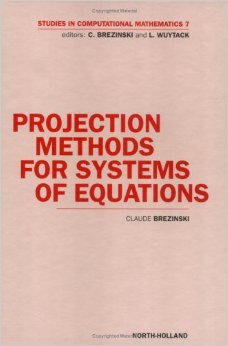
title: Projection methods for systems of equations Publisher: Elsevier Year: 1997 ISBN: 0-444-82777-3 Pages: 408 pp. Short description: A unifying approach to iterative solution of systems of linear and nonlinear equations. Published: J. Comput. Appl. Math. Newsletter MSC main category: 65 MSC category: 65F99 |
|
Review:
The literature about iterative solution of systems of linear and nonlinear equations is very extensive, especially in the last few decades, there has been an explosion of papers and books related to the subject. In this book Claude Brezinski has written down his insights in this chaos of methods and approaches. He gives unifying frameworks to classify and understand the many different methods. The underlying idea is that in all these methods, the large problem at hand is somehow projected onto a smaller subspaces and these projections are computed iteratively, so that the computations are fast. These projections can be orthogonal or oblique and often the relation with formal orthogonal or biorthogonal polynomials is obvious, but also the relation with several extrapolation (i.e., convergence accelerating) methods is explained. The emphasis is on methods for linear systems, but there is also an extensive chapter on the generalization of these methods to nonlinear systems. The book is intended for researchers in the field who will greatly appreciate it not only for providing this unifying framework but they will certainly make use of it as an excellent guide to the literature. There is a long list of 560 references and at many instances in the text, the reader is referred to them for further detail. Sometimes these references are of some historical interest, since they indicate where some idea was introduced for the first time. The book contains also several new ideas that at the present state of the art may not have been fully explored yet. For example, there is a chapter on hybrid procedures that combine several iterative methods to get the best out of several worlds. Also semi-iterative methods based on them are explored and the ideas around Richardson´s projection are not generally known. In conclusion, the book is intended for researchers in the field, but can also be read by advanced students, for whom it may open opportunities for new directions of research. However, it can also be useful for practitioners who want to learn about the most recent evolutions.
Reviewer: A. Bultheel (KU Leuven)
© June 11, 2015