|
Author(s): Dario Bini and Victor Pan
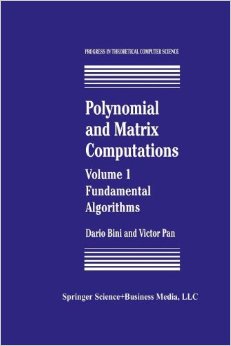
title: Polynomial and Matrix Computations. Volume 1: Fundamental Algorithms Publisher: Birkhäuser-Verlag Year: 1994 ISBN: Pages: xvi + 415 pp. Short description: This work discusses the design of algorithms for matrix and polynomial computation. Published: J. Comput. Appl. Math. Newsletter 54(3) N3-N4 (1994) jcam MSC main category: 68 MSC category: 68W01 |
|
Review:
This work discusses the design of algorithms for matrix and polynomial computation. More especially, univariate polynomials and dense structured matrices such as Toeplitz and Hankel matrices whose relation with polynomials is well known. In this respect, it can be considered as a successor of the classic by A.V. Aho, J.E. Hopcroft and J.D. Ullman: The design and analysis of computer algorithms, Addison-Wesley, 1976.
The book is successful in narrowing the gaps between numerical and symbolic computation and between matrix and polynomial algorithms. To the existing classics in this field, it adds the discussion of recent developments and of parallel computation. However, by touching upon so many topics, which require so many different backgrounds that many readers may not have, one is practically forced to read the book from cover to cover. By a persistent integration of the different approaches and subjects, one section of the book will not only treat a specific topic, but it will be related to many other topics and sections as well. Hence, the more advanced reader will find it difficult to separate the well known material from the more advanced topics he is interested in; the numerical analyst will repeatedly be confronted with techniques from symbolic computation; etc. The four chapters (polynomials, matrices, bit operations, parallel algorithms) form each an organic whole and even between the different chapters, permanent referencing back and forth gives the reader a feeling of being drowned in a somewhat unstructured ocean of information.
But, if one is prepared to swim through it, a lot of information is available indeed. The first two chapters do not contain many surprises discussing classical polynomial problems (evaluation, interpolation, Newton's method, Euclidean algorithm, Chinese remainder theorem, with an emphasis on the role of FFT) and matrix problems (mainly structured matrix problems inspired by a polynomial counterpart such as Toeplitz, Hankel, Sylvester, Bezout, Cauchy, Hilbert, Loewner, Krylov, low displacement rank, etc.). Chapter 3 on finite precision arithmetic, brings the computations down to bit level and Boolean complexity measures. It includes a discussion of numerical stability and data compression. The numerical analyst will find useful information, but will probably be disappointed in not finding a thorough justification of the algorithms proposed in this book. The last chapter discusses the complexity of the algorithms on a parallel computer at a high level, staying well away from practical implementation.
Reviewer: A. Bultheel (KU Leuven)
© June 11, 2015