|
Author(s): Ranjan Roy
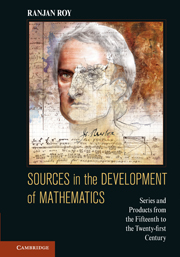
title: Sources in the development of mathematics Publisher: Cambridge University Press Pages: xv+974 Year: 2011 ISBN: 978-0-521-11470-7 (hbk) URL: www.cambridge.org/ve/academic/subjects/mathematics/history-mathematics/sources-development-mathematics-series-and-products-fifteenth-twenty-first-century?format=HB Short description: Picking up different mathematical topics like series, producs, algebraic equations, differential equations, orthogonal polynomials or more specific ones like the integration of rational functions, the authors presents in the relatively short chapters, the historical approach and solution to the topics roughly in the period from 15th to 21st century. There is history of course, but the mathematics prevail. This is calculus and more since the Renaissance placed in its historical context. Bull. BMS: vol. 22(5) p.844-845, 2015 MSC main category: 01 MSC category: 01A05 |
|
Review:
The subtitle Series and products from the fifteenth top the twenty-first century sheds some light on what the starting point was for the author. Infinite series were discovered some 200 years before Newton discovered them in 1660. But this book in about much more than series and products.
Its format is unlike other history books. First of all it is a about mathematics with exercises added to every chapter asking to prove formulas that relate to the material discussed. There are 44 chapters on diverse topics, among which of course series expansions and products show up regularly. The author is known from his book on special functions (1999) that he co-authored with G. Andrews which explains his special interest in the chapters on hypergeometric and q-hypergeometric series.
However, the subjects discussed cover a rather broad spectrum of mathematics: calculus, differential equations, number theory, harmonic analysis, algebra, finite fields, and many more.
Each chapter takes up a particular thread like for example orthogonal polynomials, or a more specific one: the integration of rational functions. The topic is then explored from an historical perspective of about 20 pages. Each chapter can be read independently. You can find there who considered the problem, how it was approached, what were the different solutions proposed, etc. Hence each chapter sweeps through history for a longer or shorter time span. Every chapter ends with notes on the literature if you want to read more. This makes the text very readable, because it is not constantly interrupted with footnotes or references.
The mathematics are always presented in modern familiar notation, so that the reader is not confused by obscure formulations.
It is entertaining and easy reading that can be consumed by chapters. It is however not very practical to take it along to read on the train or the bus because it is quite thick and heavy to hold or carry.
Reviewer: A. Bultheel (KU Leuven)
April 29, 2015