|
Author(s): Dingyü Xue, Yangquan Chen
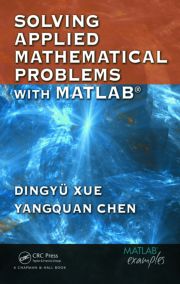
title: Solving applied mathematical problems with MATLAB Publisher: CRC Press, Chapman & Hall Pages: xiv+432 Year: 2009 ISBN: 978-1-4200-8250-0 (hardcover + CDROM) URL: www.crcpress.com/product/isbn/9781420082500 Short description: Matlab code is used to treat diverse subjects from culculus and algebra. The illustrations are not all elementary. The cdrom contains power point presentations of the chapters. Bull. BMS: vol. 20(4) p.766-767, 2014 MSC main category: 97 MSC category: 97N80 |
|
Review:
Matlab is besides maple and mathematica one of the most widespread packages for the design of algorithms to solve complex numerical problems. While matlab originally did the numerics with matrices, maple and mathematica were more set up as formula manipulating systems. However this is remote past now and the packages all have both numerical and symbolic computational facilities on top of extensive graphical possibilities. Many books with illustrative matlab examples have been published. Some of them were courses in numerical analysis, using matlab as a tool, others were introductions to matlab using the numerical problems as examples. This book is aiming at the middle road: a minimum of matlab and of numerics is introduced, and aims mainly at explaining how one may obtain a solution for the problem using matlab. However, several of these methods require functions from toolboxes that are not standard in the core set of matlab. One toolbox that is used throughout is the symbolic toolbox. It allows some symbolic manipulation of formulas but has also a somewhat less elegant interface with a maple kernel. However if one wants to go for all the applications, then 9 other matlab toolboxes and 3 free toolboxes are needed. Not only is matlab already quite expensive, each toolbox licence is another cost that is not negligible. In that case free software like SciLab of Octave might come to mind as a viable alternative, but all the re-programming that would be necessary will melt away the straightforward approach followed here.
After an elementary introduction to matlab (object oriented programming and graphics could have been elaborated more), topics are calculus, linear algebra, integral transforms, nonlinear equations and optimization, differential equations, interpolation and approximation, probability and statistics, and one chapter on other tools (fuzzy logic, neural nets, genetic algorithms, wavelets,etc.). The problems that are solved are not really very elementary. How to get the most advanced solutions with the least possible effort, using as much as possible the available matlab codes, seems to be a paradigm of the authors.
The CDROM contains powerpoint slides for each chapter that can be immediately used for teaching, or modified as desired and of course. Also the matlab scripts for all exercises are there. When clicking an icon in the slides, it copies the matlab code to the clipboard to be pasted into the matlab screen. Other icons allow you to open some code in the matlab editor. A pdf would have been less depending on Microsoft, but would have been less flexible to modify. Furthermore, there is a pdf with the solutions to all the problems that come with each chapter. The formulation and the numbering is not always the same as in the book though, but that can be considered to be a minor flaw. So this volume has many interesting cases to illustrate the power of matlab. The reader should however be somewhat familiar with programming, analysis and master some numerical algorithms if he/she wants to really understand what is going on. I consider the need of these many toolboxes a drawback for the usability of the cases, unless one is only interested in one of the applications.
Reviewer: A. Bultheel (KU Leuven)
January 23, 2013