|
Author(s): William F. Lindgren, Thomas F. Banchoff (eds)
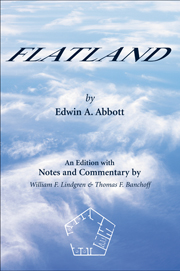
title: Flatland by Edwin A. Abbott. An edition with notes and commentary Publisher: Cambridge University Press Pages: ix+294 Year: 2010 ISBN: 978-0-521-75994-6 (softcover) URL: www.cambridge.org/aus/catalogue/catalogue.asp?isbn=9780521769884 Short description: This is an abundantly annotated edition of the classic by E.A. Abbot. Bull. BMS: vol. 21(3) p.574-575, 2014 MSC main category: 00 MSC category: 00A09 |
|
Review:
Edwin Abbott Abbott published Flatland. A Romance in Many Dimensions in 1884, with a second edition shortly after. Since then it has become a classic like the contemporary Alice in Wonderland by Lewis Carroll. There are many parallels between these two but Alice in Wonderland is more fairy-tale like while Flatland is a satire for grown-ups, yet with great imaginary power but told in an almost scientific style.
Flatland is the story told by A. Square an inhabitant of Flatland living in a two-dimensional world. He has some illusion about Lineland, a one-dimensional world. Just as difficult as his conversation with the king of Lineland, is Square's discussion with the Sphere from Spaceland when the latter is visiting Flatland. However, when instructed by Sphere, A. Square gets some insight in Flatland as seen from Spaceland. However when trying to explain this, he is misunderstood by his cohabitants, and is detained. So he is writing his story in prison.
The point made is that we can see what is happening in a lower dimensional world, but it is difficult to think just as the inhabitants of that world will think. The message is that just as we read about A. Square's difficulty to communicate with a lower as well as with a higher dimensional world, we should think about the possibility of us living in a three-dimensional subspace of a higher dimensional world too.
Besides the mathematical aspects, this satire is also a critique of Victorian society with many references to the classical Greek culture. The editors of this book are two mathematicians, but they have done an excellent job in giving many detailed background information and hidden references. The basic text by Abbott is printed on the left-hand page and the corresponding comments are printed on the opposite one.
When there came some critique after the first edition, Abbott wrote an introduction for the second one. There he had for example to ward off the critique saying that perfectly flat objects have no thickness and will therefore be invisible. For a good understanding of this part, one has to know the story already. So here the editors have decided to add the introduction as an epilogue, but the base text is equal to the second original edition (with indications where it differs from other editions). The editors have also added a chronology of Abbott's life, and a short ``mathematical biography'' as well as his obituary. Since women in Flatland are so very different from males, another appendix giving a short account of women education in Victorian England is very instructive. Also a survey of reviews of the original publication, the list of references and the name and subject indexes are very useful if the reader wants to elaborate on some of the aspects of the already rich content. Let me conclude by pointing out that this is not the first edited version of Flatland, and probably not the last. I confine myself to mention here the version by Ian Stewart (2002) and the sequel Flatterland (2001) that he wrote. Also the computer animated films by L. Ehlinger Jr. and by Johnson and Travis (both 2007) and related publications like Spaceland by R. Rucker (2002) are worth noting.
Reviewer: A. Bultheel (KU Leuven)
January 23, 2013