|
Author(s): Bernard Beauzamy
title: Archimedes' Modern Works Publisher: Société de Calcul Mathématique, S.A. Pages: 220 Year: 2012 ISBN: 978-2-9521458-7-9 (hardback) URL: www.scmsa.eu/archives/SCM_Archimedes_order.htm Short description: This is a view on the work by Archimedes and his way of thinking. It also evocates the way in which Archimedes would have solved some problems of modern interest if he had lived today. Bull. BMS: vol. 22(1), p. 175-176, 2015 MSC main category: 01 MSC category: 01-XX |
|
Review:
Most people will recognize that Archimedes is among the greatest scientist from the Greek period with prime influence on the evolution of mathematics. The author of this book is obviously one of his greatest fans. The book is written as if he wants to reinstall Archimedes as the greatest of all and fight the historical conspiracy to minimize his influence. The cover text quoting ``Satan is in charge and Archimedes drives the show!'' is characteristic but he also interrupts his mathematical exposition with linguistic hyperboles like ``Not so fast folks, not so fast! Remember we are dealing with the masterpiece of one of the greatest geniuses of all times. This masterpiece is basically at the origin of all mathematics which followed,...'' or ``when we are told that this proof is 2200 years old, we are astonished and irritated. Three times each.''. Astonished refers to the fact that since Archimedes laid the foundations so brilliantly, mathematics has not advanced much. Archimedes (implicitly) knew the principles of integral calculus. Irritation refers to the fact that neither Leibniz nor Newton, nor any other mathematician refers to Archimedes directly and that Archimedes' work was never correctly translated or understood and neither is it taught anymore to the next generation.
This being said, let's now come to the actual content. There are three parts. Part I is about Archimedes maps. It gives the author's interpretation of a work by Archimedes where he proves that the area of a spherical cap equals the area of a circle whose radius is the distance from the summit of the cap to a point on the border. His source is a French translation by Ch. Mugler (2003). Then, inspired by the proof of this result, Beauzamy introduces a conformal projection from the sphere to the plane (as an alternative for Mercator's projection) which is actually the same as Lambert's projection (1772). This idea is generalized in several directions, and as a `modern application' he considers the subdivision of an area (e.g. a country) in equal parts according to some density distribution (e.g. its population).
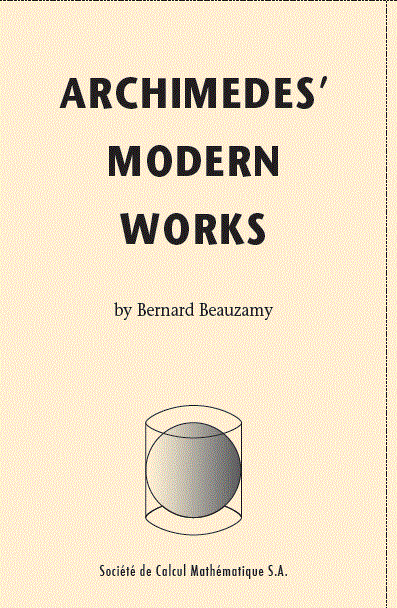
The second part gives a similar interpretation of `The Method' another text by Archimedes as found in another translation by Mugler. It is a proof of a result that Archimedes was most proud of and that was engraved on his tomb: the volume of a cylinder circumscribing a sphere is 3/2 of the volume of the sphere. The proof uses a comparison between volumes of two cylinders, a cone and the sphere. Equalities correspond to an equilibrium state when moving some lines in the geometric construction. This is actually a mechanical equilibrium where the area of a mathematical disk is interpreted as the weight of an infinitesimal thin physical disk. The latter is closely related to computing the center of gravity of the objects. For example, it is an immediate consequence that the center of gravity of a cone of revolution is at 3/4 from the top. Other similar results can be obtained using the same methods.
Beauzamy then gives generalizations and `modern' applications. This `method of weighing' can be applied to any situation where a `weight' density function is defined over some domain. Not only for computing the center of gravity, but also for applications in probability theory, for finding the distribution of the zeros of a polynomial, given the uncertainties of its coefficients, for optical applications where the refraction indices of the two media can be considered as weights (minimizing the weighted length traveled by the light defines the refraction path). The last application is about using ultrasonic testing a tube of a steam generator for flaws. This is by using Archimedes' method because `emitted and received signals are compared' and the technique of Archimedes is all about comparing something known with something unknown. This item is vague and the link with Archimedes remains rather unclear.
The third part contains some historical texts on Archimedes that were reproduced from websites and some short texts by the author. For example his letter to the Mayor of Syracuse where he complains about the fact that nobody seems to know with certainty where the tomb of Archimedes is really located.
The text is only interesting if you want to learn Beauzamy's interpretation of the way Archimedes was thinking and how he thinks that some `modern problems' would have been solved by Archimedes if he had lived today. The style and structure is somewhat chaotic and switches between a plain mathematical exposition and some personal outbursts of enthusiasm or irritation. Beauzamy inserts gaps (missing proofs) and extends and applies the results, but it is not always clear where the interpretation ends of what Archimedes has actually written according to the historical source or which part of the source is used. Also, being published by the author's own company could explain why there are some flaws in the English sentences (Newton `et' Leibniz, `surface' for `area', `further' for `farther',...) reference to a French wikipedia site,....
Reviewer: A. Bultheel (KU Leuven)
January 23, 2013