|
Author(s): Matthias Baaz, Christos H. Papadimitriou, Hilary W. Putnam, Dana S. Scott, Charles L. Harper, Jr. (eds.)
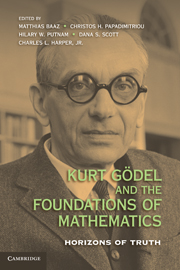
title: Kurt Gödel and the Foundations of Mathematics. Horizons of Truth Publisher: Cambridge University Press Pages: 540 Year: 2011 ISBN: 978-0-52176-144-4 (hardback) Price (tentative): 60 £ (hardback) (net) URL: www.cambridge.org/aus/catalogue/catalogue.asp?isbn=9780521761444 Short description: These are the proceedings of a conference on Gödel's work. The papers deal with historical issues and the impact of Gödel's contributions in the time of writing as well as how they contributed to the future of current logic. Bull. BMS: vol. 22(3) p.526-527, 2015 MSC main category: 03 MSC category: 03-03 |
|
Review:
In April 2006, a conference Horizons of Truth was held in Vienna, to celebrate the Kurt Gödel (1906-1978) centenary. Although this book does not really contain the proceedings of the conference (the initiative to compile it came only afterwards) it is a collection of contributions from the invited speakers at the conference. All authors are well known in their field of expertise and the selection covers all the areas on which Gödel had some impact. Some of the authors have known Gödel personally but there is no contribution in the form of an extensive and detailed biography. There is a short summary in the beginning, but more details can be found, scattered in some of the contributions. Not only the contents but also the style of the contributions are quite diverse. Some are technical, some are philosophical, others much more historical.
The papers are organized in three parts.
The detailed table of contents can be seen at the website of the publisher.
We give a brief survey.
The first part is mainly historical and contains 10 papers
on Gödel's results and their (immediate) impact on
mathematics, philosophy, logic, computer science, cosmology,
and theoretical physics.
While the impact on logic was immediate and tremendous, it didn't hinder
much the evolution of mathematics.
One learns also how it was received by other scientists and how Gödel exchanged ideas
with his peers. It is remarkable that Hermite only briefly referred to Gödel, although
Gödel solved the problems posed by Hermite, and neither did Turing refer
to Gödel, while he reformulated Gödel's incompleteness theorem in terms of
computability.
The second part gives a wider vision, stressing interdisciplinary aspects, including
philosophical and even religious implications.
One can read about provable unknowables in physics, an analysis of Gödel's ontological proof of the existence God, and the unknowability of God, what
Gödel's theorem says about
the capacities of the human mind, etc. All this is discussed in the 6 papers of this part.
The third part has 5 papers and looks at new frontiers.
I.e. about what is beyond Gödel's work in mathematics and symbolic logic.
It includes its current use, modern interpretation, and progress, e.g. concerning Gödel's functional interpretation, the transfinite universe, set theory, and computational complexity (P=NP problem).
Gödel's fundamental results have an impact on many different research fields, if not on the foundations of all human intellectual activity. So this book will be on interest to many researchers. Even if your research field is not directly linked to Gödel's results, this book will still be largely interesting. In such case you might want to skip some of the papers, but enough interesting contributions remain to learn about the mind of a giant, on whose shoulders science could progress.
Reviewer: A. Bultheel (KU Leuven)
January 23, 2013