|
Author(s): Michele Emmer (ed.)
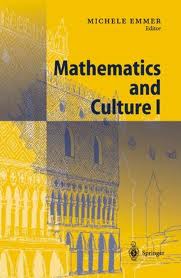
title: Mathematics and Culture I Publisher: Springer Verlag Pages: viii+352 Year: 2004 ISBN: 3-540-01770-2 URL: www.springer.com/book/978-3-540-01770-7 Short description: A collection of essays on the link between many forms of art and mathematics. Bull. BMS: vol. 12(3), p. 476, 2005 & newsletter issue 50, 2004 MSC main category: 97 MSC category: 97M80 |
|
Review:
These are the English translations of the proceedings of a conference on Mathematics and Culture held in Venice in 1999. The original Italian version appeared as Matematica e Cultura 2000. This type of conferences takes place on a regular basis. The proceedings of the 2000, 2002 conferences are available in Italian only. The proceedings of the 2004 conference is announced in English. We should also mention the book by M. Emmers and M. Manaresi Mathematics, Art, Technology and Cinema which appeared in 2003 but which was conceived as a contribution to the world mathematical year 2000.
That mathematics has a great impact on all aspects of society and vice versa, is obvious, but it is rarely seen that mathematicians lecture about social issues or that artists lecture about the impact of mathematics on their art. This book gives a cross section of all this. Each of the 27 contributions, grouped in 11 chapters are warmly recommended reading.
One may find a discussion of the tension between mathematics teaching and mathematics research, but also on the history and the importance of the mathematical development of linear and nonlinear programming and its impact. More historical are the contributions about the mathematical scenery under repressive political regimes, like fascism in Italy and Germany or the former Russian regime. Also the influence of mathematics on economy has direct consequences for the evolution of societies. There is no Nobel price for mathematics, but nevertheless there are several mathematicians who won Nobel prices in different areas. Very interesting is the parallel that is drawn between the historical evolution towards mathematical abstraction and the corresponding concepts that were governing the arts at the same time. My favorite chapter is the one on mathematics and cinema. There is a great analysis of the film Moebius made by students of the Universidad del Cine de Buenos Aires in 1996, and Peter Greenaway uncovers the concepts that he used to make all his films, of which Drowning by numbers is just one step in the evolution. But the feast goes on and there is much more. What would be the concept of a mathematics museum? How to popularize mathematics? What relations are there between mathematics and literature and music? Furthermore, there is a chapter on mathematics in Venice (the conference place), on mathematics and technology (visualization, cryptography), on mathematics and medicine (diagnosis, risk analysis, Radon transform), etc.
In summary: a delight to be read by any mathematician who is prepared to admit that he is part of the society and by anyone else who cares to admit that mathematics has a tremendous impact on the world he lives in. Buy it! Read it!
Reviewer: A. Bultheel (KU Leuven)
January 27, 2013