|
Author(s): Nobuyuki Yoshigahara
title: Puzzles 101, A puzzlemaster's challenge Publisher: A K Peters Pages: x+121 Year: 2004 ISBN: 1-56881-206-X URL: www.crcpress.com/product/isbn/9781568812069 Author(s): Peter Winkler title: Mathematical puzzles, A connoisseur's collection Publisher: A K Peters Pages: xi+163 Year: 2004 ISBN: 1-56881-201-9 URL: www.crcpress.com/product/isbn/9781568812014 Short description: A collection of entertaining logical and mathematical puzzles. Bull. BMS: ♠ MSC main category: 00 MSC category: 00A08 |
|
Review:
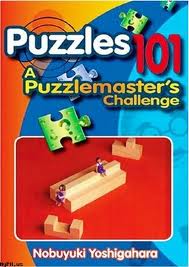
The group of ``puzzle-masters'', i.e., those that really invent new (mathematical) puzzles is relatively small, yet, as Yashigahara writes in his preface, their creations, i.e., the puzzles, are spread by word from mouth to mouth and from generation to generation, just like sagas and fairy tales are, and they sink down in a collective memory and become elements in the recreational backpack of many who enjoy brain gymnastics. New puzzles, like jokes, spread across the world like an epidemic, and it is not always clear who the creator was and what the original version was like. Nowadays, the internet will contribute to archiving and spreading these brain teasers. In his book Yashigahara, collects 101 puzzles that he created or that he particularly liked. It is a mixture of easy and difficult, but always entertaining, problems. Knowledge of ``real'' mathematics is not necessary at all. Some of them are not even mathematical. For example: on a digital clock you may read 3:59:53 which is palindromic (ignoring the ``:''). What are the two palindromic times that are nearest? Or an example of a non-mathematical one: can you find a caligraphic writing of the name of the author: Nobuyuki Yoshigahara such that if you turn it upside down, it reads the same. All solutions are provided in the second half of the book. The format and size of the booklet is clearly adapted to the public that buys collections of cross-word puzzles in magazine shops and supermarkets.
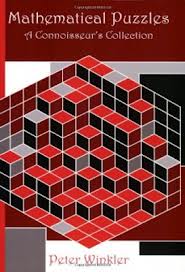
The second book by P. Winkler is a bit more mathematical (but not always), although again no professional knowledge of mathematics is needed to solve the puzzles. Here it is a collection of about 100 puzzles. Not all of them are created by the author. If the source of the puzzle is known, it is mentioned. The criterions that the author used for selecting the puzzles are amusement (they should be entertaining; it is not a math test!), universality (they must rely on some general mathematical truth), elegance (they should be easy to formulate), difficulty (they should not be obvious), and solvability (at least one solution should exist that is easy to grasp). Obviously, the latter does not hold for the puzzels in the last chapter with a title ``Unsolved puzzles''. The puzzles are organized in chapters classifying them loosely around some topic like numbers, games, geometry, etc. Solutions are given at the end of each chapter. The fact that there is an elegant solution does not mean that the puzzles are simple. On the contrary, some were open probems for a long time before somebody came up with the solution that is included. An sample puzzle is: how many times does one have to roll a die before all six different numbers have shown up at least once? And a ``non-mathematical'' one: which two states contain the most distant points in the US? (The mathematics are hidden in the distance on the surface of a sphere.)
With these books many hours of puzzling pleasure is guaranteed. Solving one puzzle is a victory already. The one who can solve all these puzzles in his lifetime is a genius.
Reviewer: A. Bultheel (KU Leuven)
January 27, 2013