|
Author(s): Peter Deuflhard, Andreas Hohmann
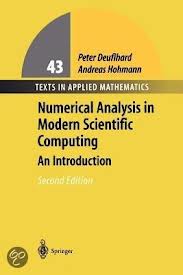
title: Numerical analysis in modern scientific computing. An introduction Series: Texts in Applied Mathematics, vol. 43 Publisher: Springer Verlag Pages: xviii+337 Year: 2003 ISBN: 0-387-95410-4 URL: www.springer.com/book/978-0-387-95410-3 Short description: Can be used as a course in numerical analysis. Bull. BMS: vol. 11(3) p. 479-480, 2004 MSC main category: 65 MSC category: 65-xx |
|
Review:
The title of this textbook characterizes pricisely its scope and contents. It can be used as a first course on numerical analysis at an advanced undergraduate or early graduate level. It has a slight bias towards numerical linear algebra, but that is justified because this takes a prominent place in many modern scientific computing problems. There is of course the unavoidable chapter on numerical stability, conditioning, and error analysis in floating point computations. Furthermore there are the chapters on interpolation and approximation (including splines and Chebyshev polynomials) and on numerical quadrature (including Gauss-Christoffel, Romberg and multigrid techniques). Both of these chapters are restricted to the one-dimensional case. All the other chapters are basically linear algebra: linear systems, (linear and nonlinear) least squares, and eigenvalue problems. The computation of zeros and fixed point iteration is hidden in the nonlinear least squares chapter. Again all the important techniques used in current scientific computing are introduced: conjugate gradients, Lanczos, bifurcation, fast Fourier transform, etc. The chapter on the solution of three-term recurrence relations is somewhat uncommon in textbooks of this type. However, the computation of a non-dominant solution of these difference equations is numerically highly instructive and relevant for other applications. The balance between theoretical analysis and basic algorithmic approach is optimal for a broad range of students with a mathematics, computer science, engineering, or even with a general background in science. Besides some polishing of the text, the main novelty in this second edition is the introduction of the stochastic eigenvalue problem. Practical, enlightning, to the point, and up to date: this is the material I would like to teach to an appropriate group of students and given enough time to cover the whole text.
Reviewer: A. Bultheel (KU Leuven)
January 27, 2013