|
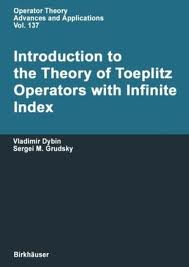
Author(s): Vladimir Dybin, Sergei M. Grudsky
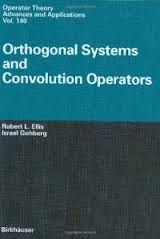
title: Introduction to the theory of Toeplitz operators with infinite index Series: Operator Theory: Advances and Applications, vol. 137 Publisher: Birkhäuser Verlag Pages: xii+299 Year: 2002 ISBN: 978-3-7643-6728-2 URL: www.springer.com/birkhauser/mathematics/book/978-3-7643-6728-2 Author(s): Robert L. Ellis, Israel Gohberg title: Orthogonal systems and convolution operators Series: Operator Theory: Advances and Applications, vol. 140 Publisher: Birkhäuser Verlag Pages: xvi+236 Year: 2003 ISBN: 978-3-7643-6929-3 URL: www.springer.com/birkhauser/mathematics/book/978-3-7643-6929-3 Short description: Two excellent volumes on Convolution and Toeplitz operators. Bull. BMS: vol. 12(1) p.153, 2005 MSC main category: 47 MSC category: 47B35 |
|
Review:
The index of an operator is the dimension of its kernel. For Toeplitz operators, the index can be obtained from an appropriate factorization of its symbol. This book is devoted to the study of Toeplitz operators with infinite index. Problems like normal solvability, the construction of left or right inverses, generalized inverses, structure of the image or the kernel etc. are studied via a detailed analysis of properties of the symbol and its discontinuities. More specifically the factorizing properties of these symbols in terms of Blaschke products and more generally inner functions are the key instruments.
The second book takes as a starting point a theorem by M.G. Krein on the location of the zeros of orthogonal polynomials on the complex unit circle. The number of zeros located inside or outside the unit disk can be obtained from counting the number of sign changes of a sequence of Toeplitz determinants build from the Fourier coefficients of the orthogonality measure which can obviously be indefinite, but is assumed to be nondegenerate. There are several different ways of formulating this property. All these variants and their generalizations to orthogonal polynomials on the circle and the real line which may be matrix or operator valued are brought together in this volume.
Both of these books (like most of the books in this series of Operator Theory) are a pleasure to read. They give a self contained accessible survey, including almost all proofs written out in full length. In this way the reader is in about 200 pages given the results of what has been achieved in the last couple of decades in the respective fields. Both have reached a certain stage of maturity so that these volumes are a tool most welcome to the scientific community. Digging up all these results scattered in the literature would be most time-expensive. Especially the hundreds of references in the first volume is impressive.
The virtuous interplay between operator theory, functional analysis, and complex analysis of the first volume will attract a broad audience. The applications can be found in mathematical physics, and to a lesser extend in integral and possibly differential equations. The same is true for the second volume, although the emphasis is a bit more on linear algebra and (obviously) orthogonal polynomials. From the applications side, engineers doing system theory or signal processing might also be interested.
Reviewer: A. Bultheel (KU Leuven)
January 27, 2013