|
Author(s): Martin Gardner
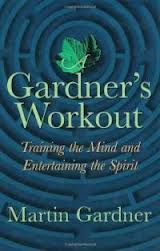
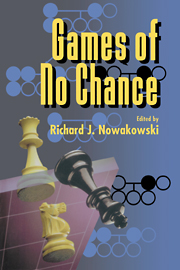
title: Gardner's workout, training the mind and entertaining the spirit Publisher: A K Peters Pages: xi+319 Year: 2001 ISBN: 1-56881-120-9 (hard cover) URL: www.crcpress.com/product/isbn/9781568811208 Author(s): Richard J. Nowakowski (ed.) title: Games of no chance Series: Mathematical Sciences Research Institute Publications, vol 29 Publisher: Cambridge University Press Pages: xiii+537 Year: 1996 ISBN: 0-521-57411-0 (hard cover) URL: www.cambridge.org/be/knowledge/isbn/item1160216 Short description: Book 1: a collection of columns of Martin Gardner not published in Scientific American. Book 2: proceedings of a conference of 1994. Bull. BMS: ♠ MSC main category: 00 MSC category: 00A08 |
|
Review:
Martin Gardner is best known for his Mathematical Games columns in Scientific American. All of his columns have been reprinted in book form. Since he stopped writing these columns be contributed from time to time similar notes to other journals and popular magazines. Thirty-four of these recreational brain teasers are collected in this volume. If appropriate, an update on the situation is added. Martin Gardner fans will love this as much as they loved the previous 15 volumes. In a second part one can find six reviews by M. Gardner of books that fit into this kind of mathematics. It includes also one essay in which he gives a very critical view of the new ``new math''. This is a movement that emerged as an anti-thesis for the abstract set theoretical approach of the new math of the sixties. Now the swing is far too much on the opposite side so that mathematics are totally lost in questions of political correctness, in experimentation and integration, in environmental issues etc., so that simple calculus questions or the simplest proofs are degraded to something unimportant and not even worth training.
The second book is more mathematical and contains the proceedings of a 1994 workshop on combinatorial game theory. The big shots of this part of mathematics contributed: E. Berlekamp, J. Conway, R. Guy, A. Fraenkel, etc. Many of these names also show up in Gardner's columns. Four parts can be distinguished among the contributions: introductory papers, papers on classical games (e.g. chess and Go), papers on more advanced and more general games, and new theoretical views. There is also an open problem section and an extensive bibliography.
Reviewer: A. Bultheel (KU Leuven)
January 29, 2013