|
Author(s): Wojciech Szpankowski
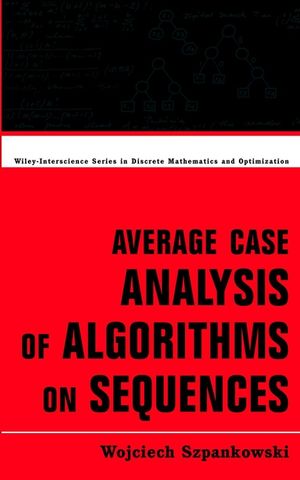
title: Average case analysis of algorithms on sequences Series: Wiley-Interscience series in discrete mathematics and optimization Publisher: John Wiley & Sons Pages: xxii+551 Year: 2001 ISBN: 3-471-24061-X (hard cover) URL: eu.wiley.com/WileyCDA/WileyTitle/productCd-047124063X.html Short description: Provides the mathematical tools for anyone who has to work with sequences. Bull. BMS: vol. 9(4) p.640, 2002 MSC main category: 68 MSC category: 68-02 Other MSC categories: 60C05, 68W05, 68W40 |
|
Review:
The sequences of the title are to be understood in the sense of strings of words like in bit strings, text, or DNA strings. Such objects show up in many scientific applications and they are analyzed and processed by algorithms. To study these algorithms diverse mathematical techniques are used. They include complex analysis, probabilistic tools, combinatorics, integral transforms, etc. An introduction to all these subjects and a survey of the necessary results are given and the applications are explained. Although the material is built up from scratch, it is presented in a rather compact form, and a certain amount of mathematical maturity is needed to keep up with the author. In some 500 pages, the reader has to digest data structures, data compression, Markov chains, complex analysis, order statistics, moment methods, ergodic theorems and martingales, information theory, formal series (generating functions), Mellin and Poisson transform plus their inversion, asymptotic expansions, and also all the applications. Of course the applications are the ultimate reason for collecting all these mathematics, they do not make up the largest part of the text. They serve as a motivation, but the mathematical disciplines stand out as such. Of course many of the classical theorems of these disciplines are well known, so they are given without proof. Proofs are included for the more specific results only. There are also a number of exercises provided after each chapter. These range from straightforward to open problems. One could describe it as an advanced mathematics course for informatics students. This book is another proof of the fact that informatics has become a mature and rigorous branch op applied mathematics raising new problems and coining new results and research directions that are built up from the more traditional mathematical minerals.
Reviewer: A. Bultheel (KU Leuven)
January 29, 2013