|
Author(s): Tino Gramß, Stefan Bornholdt, Michael Gross, Melanie Mitchell, Thomas Pellizzari
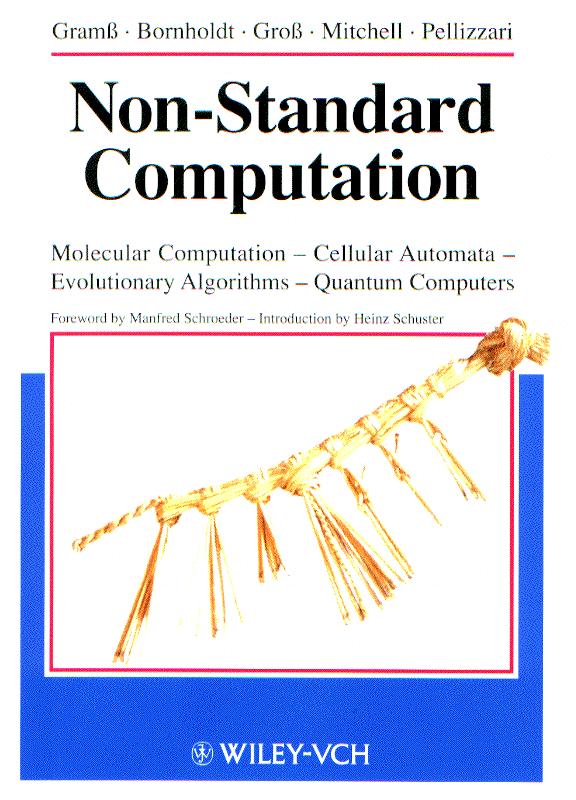
title: Non-standard computing Publisher: Wiley-VCH Pages: ix+226 Year: 1998 ISBN: 3-527-29427-9 (soft cover) Short description: Bull. BMS: vol. 8(3) p.543-544, 2001 & vol. 9(1) p.157-158, 2002 MSC main category: 68 MSC category: 68Q99 |
|
Review:
At the end of the second millennium, the classical Von Neumann computers are widely used, and they still are sold with processing speed and memory capacity that is multiplied by a factor every so many years. However, the mainstream of these performance improvements are based on the classical idea of sequential processing of the data. Some improvements can be obtained if a certain number of processors work in parallel. But whatever ingenious idea is used, it is only some finite factor of improvement that can be obtained. However, the best computers with a capacity that is several orders of magnitude larger than most modern computers are found in nature and are based on totally different concepts, which often reduces to the collaboration of elementary but massively many processors in parallel. A number of these ideas for the computers of the third millennium are discussed in this book. I briefly describe the ideas.
1. Molecular computation is based on the enormous power that is available in cells and molecules, and most of all, there are so many of them working together. Therefore a biological computer, based on chemical reactions would outperform a classical electronic computer by many orders of magnitude.
2. Sometimes however this biological computer can make errors. This need not necessarily be a disadvantage. For example in genetic algorithms that run on classical parallel computers, it is possible to find a global minimum in optimization problems where other algorithms would get stuck in the local minimum.
3. Cellular automata are artificial devices consisting of many very simple items that operate under certain local rules. Yet because of their interaction, they can form highly complicated patterns. So they form another instance of massive parallel computing.
4. Quantum computing is another buzz word in this area. The idea here is that in the current race for miniaturization of the chips, one could try to push the connections back to a distance of the order of the wavelengths of the electrons. This seems to be a theoretical idea for the moment, but some progress is being made in this direction. This book contains a chapter which describes ``The first steps towards a realization''.
Also for the other topics mentioned, the book has a separate chapter, written by different specialists. That gives as a whole a clear introduction for the layman. It may be a book that is inspired by the millennium hype, but it is nevertheless quite interesting both for the specialist and the occasionally interested reader. Be aware though that it is not only about mathematics, computers and algorithms, but it contains many other topics like e.g., cell biology and quantum mechanics, which makes it all the more interesting. If one is just interested in a minimal survey, it is possible to read only the introduction by H.G. Schuster, giving a summary of the remaining chapters.
Reviewer: A. Bultheel (KU Leuven)
January 23, 2013