|
Author(s): Howard Anton
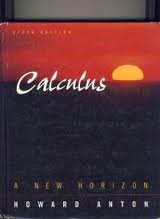
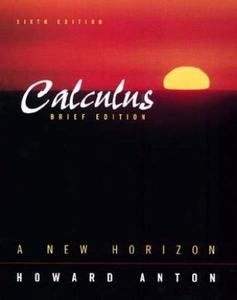
title: Calculus, vol. 1 (6th ed.) Series: A New Horizon Publisher: John Wiley & Sons Pages: xxxi+566 Year: 1998 ISBN: 0-471-24331-0 (softcover+CD) Author(s): Howard Anton title: Calculus, brief edition (2nd ed.) Series: A New Horizon Publisher: John Wiley & Sons Pages: xxxi+879 Year: 1999 ISBN: 0-471-15307-9 (softcover+CD) Author(s): Deborah Hughes-Hallett title: Calculus, single variable (2nd ed.) Publisher: John Wiley & Sons Pages: xvii+647 Year: 1998 ISBN: 0-471-16442-9 (softcover) Author(s): William G. McCallum et al title: Multivariate Calculus (intl. ed.) Publisher: John Wiley & Sons Pages: xv+647 Year: 1998 ISBN: 0-471-19428-X (softcover) Author(s): Ren F. Roley, Michael P. Dobson, Stephen J. Bence title: Mathematical Methods for Physics and Engineering Publisher: Cambridge University Press Pages: xix+1008 Year: 1997 ISBN: 0-521-55529-9} (softcover) URL: www.cambridge.org/be/knowledge/isbn/item1162976/ Short description: Bull. BMS: vol. 6(2) p.318-319, 1999 MSC main category: 97 MSC category: 97-01 |
|

Review:
We are at the edge of a new era where the new paradigma for teaching mathematics will be much more utilitarian: the ``what can it buy me'' mentality. The evolution comes mainly from the US where wide spread calculus courses for the non-professional mathematicians contain very few proofs and many applications. For example, instead of defining a derivative, the student is given a ``feeling'' of what it might be like, where it is used (``think of an average velocity, but then for a tiny time interval''), hence the following ``definition'': ``it is like a ratio where numerator and denominator become terribly small''. My sketch of the derivative is of course a bit exagerated, but it certainly gives an idea of what the ``new age'' mathematics look like. This is at the other end of what most of us European mathematicians had in their education: formal definitions and ε-δ proofs to name just those.
Ever growing influence in the mathematical teaching process is taken by the symbolic/numerical packages like e.g. mathematica and maple and taking into account the multimedia hype of these days, it is not far off that (certainly non-mathematics or non-engineering students) will be taught mathematics by a multi-media show.
There is a long lasting discussion going on about whether the above evolution is to be praised or to be damned, and this is not the place to give all the pros and cons. What I want to make clear is that, with every new edition of a calculus course, the tendency is to include more multimedia support and lecture notes rely more and more on the fact that students have computer facilities or certainly some graphical tool at their disposal, and often it is assumed that students have access to some computer algebra system. The first three books mentioned above are an illustration of this fact.
The Anton book is a part of a new edition of a calculus book that is used worldwide. It contains only the classical differential and integral calculus of a single variable (the rest is postponed to volumes 2 and 3). The main modifications in this edition are additions of certain ``modules'' which give an applied illustration of e.g. the derivative (in casu a robot-arm). Such modules will be available at Wiley's WAVE (web added value education) web site www.wiley.com/college/anton. At the moment of writing this review this was not ready yet, but a multimedia CD is enclosed in the book which gives an illustration of several such modules.
The two other books from Wiley are even more pronounced in this direction: much less formalism and much more applications. On the Wiley web site, it is announced in a newsletter that a joint project between the authors of these books and Wolfram, will make these texts available integrated mith mathematica. The classical printed book will be replaced by a multimedia, interactive CD. This explains why at certain places in the text there is a some handwaving going on.
The Cambridge volume is of quite another style. The audience (physics and engineering) needs more mathematics than an average non-mathematical university branch. Only the most elementary calculus is assumed known. Much more advanced topics are included (Fourier series, linear algebra, parial differential equations, integral transforms, complex variables, calculus of variations, probability, inegral equations, group theory, representation theory). Also here, the emphasis is not on the theory, but on the applicability and computational techniques. For example, it is explained what a line integral is (in 3 dimensions, not more), where it is used (the physical meaning), how it is denoted (with the necessary formalism), and then several examples illustrate how to compute it. These are about the same steps as used in the previous texts, but at a much higher lever, much less handwaving, and much less ``show''. To the point, practical and encyclopedic. An excellent text.
Reviewer: A. Bultheel (KU Leuven)
January 23, 2013