|
Author(s): Keith Devlin
title: All the math that's fit to print Series: Spectrum Series Publisher: The Mathematical Association of America Pages: xvii + 330 Year: 1994 ISBN: 978-0883855157 URL: maa-store.hostedbywebstore.com/ALL-THE-MATH-THATS-PRINT/dp/B003AG9NJU Short description: Bull. BMS: vol. 2(5) p.592-593, 1995 MSC main category: 00 MSC category: 00A08 |
|
Review:
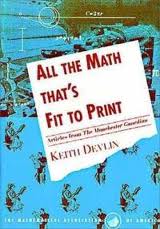
Keith Devlin is a British mathematician who, by Thatcher's educational ravages had to emigrate to California in 1987. He is editor of FOCUS, the Math. Assoc. America's newsletter and of the ``Computer and Mathematics'' column of the AMS Notices. In the period 1983-1989 he wrote a biweekly column ``Micromath'' in ``The Manchester Guardian'' newspaper. This book is a compilation of the majority of these columns. For example, a review of a book that is out of print by now is left out.
As the name suggests most of these columns address directly people who love to play with mathematics using their microcomputer as a tool for experimentation. Since the ``The Guardian'' is a general newspaper, these columns are aiming at a very broad audience, from teenagers in highschool to retired executives. Probably, because no mathematical background is assumed, only widely appealing subjects are discussed in the most general terms. Even the notation of a real number is avoided. Probably because natural numbers are widely known and problems can be easily formulated, many of the chapters deal with number theory. Several report especially about ``new'' (in those days) achievements in the computer search for large prime numbers. There is however a wide variety of other topics. Some give the ``latest news'' (again in the past decade) about proofs and alleged proofs for the 4 color problem, the Bieberbach conjecture, the Riemann hypothesis, Fermat's last theorem etc. Some mathematical puzzles and logical paradoxes are discussed. Some columns deal with artificial intelligence, computer viruses, computational complexity, chaos and fractals, etc.
This book will certainly be appealing to numerous people with a tangential mathematical interest, who love to ``play'' with mathematics, preferably with integers and who program their PC as a hobby. For the ``real'' mathematician, the talking-around-the-problem and the absence of technical solutions may be somewhat irritating. Yet, from an historical viewpoint, it is quite interesting to see the invasion of computers in mathematics taking place, even in only one decade. It is also informing to notice what kind of mathematics managed to reach the front page of the newspapers in the eighties.
Reviewer: A. Bultheel (KU Leuven)
January 23, 2013