|
Author(s): Philip J. Davis
title: Spirals, from Theodorus to Chaos Publisher: A K Peters Pages: ix+237 Year: 1993 ISBN: 978-1568810102 Short description: Bull. BMS: vol. 2(2) p.231-232, 1995 MSC main category: 00 MSC category: 00A05 Other MSC categories: 01A75, 52-03, 58F13 |
|
Review:
At the annual meeting of the Mathematical Association of America, it has been a central feature in the last 75 years to have a series of lectures, called the Hedrich lectures in honour of Earl Raymond Hedrich, the first president of the MAA.
The subject chosen by P.J. Davis for these jubilation lectures was ``spirals''. This book gives the text of the lectures and some related material.
Before I read this book, it never crossed my mind that spirals were objects of great mathematical interest. Of course, one comes across spirals in art and in nature, galaxies are like spirals, there are even pastries baked in spiral form. And if you think a while, you realize that we are surrounded by spirals. And spirals are as old as mankind. P.J. Davis never mentions the beautiful spiral artwork at the entrance stone of the grave-mound in Newgrange (Ireland) which is much older than Stonehenge. Yet, spirals are not an object of intense current mathematical teaching. At most, the spiral of Archimedes is mentioned in undergraduate mathematics as an example of a curve that can be described easily with polar coordinates, as a mathematical idiosyncrasy, so to say.
Davis takes a rather liberal approach to the subject. He drawns the reader a whirlpool (spiral again) of history, philosophy, anecdote and mathematics, all related to spirals, or at least inspired by them.
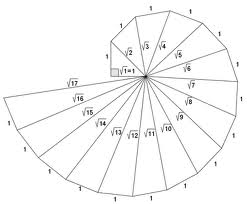
The spiral is given in the complex plane by the difference equation $z_{n+1} = z_n + i z_n/|z_n|$ ($i=\sqrt{-1}$). It can be seen as a succession of rectangular triangles. The polynomial line obtained by connecting $z_1 = 1$, $z_1 , z_2 , \ldots$ consists of pieces of length 1 and therefore the corresponding rays to the origin have length $|z_n| = \sqrt{n+1}$. It is speculated that Theodorus stopped at $n = 17$ because then the spiral moved over about $360^\circ$.
Next he asks the question, what is a spiral ? He presents many pictures which all look like spirals to us and we are brought from a simple idea to much more complex mathematical ideas. This brings him to the conclusion that ``There are even days when I think that all curves are spirals''.
The solution of the Theodorus equation can be written as $z_{n+1} = (1 + i/ \sqrt{n+1} ) z_n$ and this motivates the author to study the function $T(a) = \prod_{k=1}^{\infty} (1+i/\sqrt{k} )/(1+i /\sqrt{k+a})$ as a brand new special function. He defines its slope as it crosses the $0^\circ$ ray as a world constant $T$. Due to slow convergence, the numerical computation of $T$ or of $T(a)$, which may be seen as a smoothed version of the Theodorus spiral, is not a trivial matter and in a supplement, W. Gautchi displays a lot of numerical skill to compute them accurately.
Finally generalizations like $z_{n+1} = a z_n + bz_n / |z_n|$ or in more complex variables, the vector difference equation $v_{n+1} = Av_n + Bv_n / \| v_n \| +C$ are discussed. Now all kinds of nonlinear dynamics, bifurcations, chaotic behaviour etc. come to the picture. A detailed study is given by A. Iserles in another supplement.
The text of Davis is sprinkled with many footnotes, some of mathematical or historical nature, but many digress in philosophical contemplations about the mathematical and social society, some are amusing anecdotes.
A last part of the book contains 8 commented translations of text fragments related to spirals. They span over 2500 years (Plato, Archimedes, Tonicelli, Bernoulli, Sylvester, Poincaré, Hlawka). It is quite interesting to see how mathematicians have changed their approach to the same mathematical object after a couple of centuries.
I can confirm the last sentence of the cover text of the book: His [Davis] tale will undoubtedly fascinate mathematics lovers of all levels.
Reviewer: A. Bultheel (KU Leuven)
January 27, 2013