|
Author(s): R.D. Harding, D.A. Quinney
title: A simple introduction to numerical analysis Publisher: Adam Hilger Pages: ix+125 (+ floppy disk) Year: 1986 ISBN: 9780852741542 Author(s): A.W. Bowman, D.R. Robinson title: Introduction to statistics Publisher: Adam Hilger Pages: ix+205 (+ floppy disk) Year: 1987 ISBN: 9780852744086 Author(s): I.P. Castro title: An introduction to the digital analysis of stationary signals Publisher: Adam Hilger Pages: xi+148 (+ 2 floppy disks) Year: 1989 ISBN: 0852742541 Author(s): J.J. McKeown, D. Meegan, D. Sprevak title: An introduction to unconstrained optimisation Publisher: Adam Hilger Pages: x+122 (+ floppy disk) Year: 1990 ISBN: 978-0750300254 URL: www.crcpress.com/product/isbn/9780750300254 Short description: Bull. BMS: ♠ MSC main category: 62 MSC category: 62-01 |
|

Review:
The original software provided with these books was for BBC computers, but it is now also made available for IBM compatible PC's. Hence the discrepancy in the publication date of the text and of the disks.
All of these were published in the series of computer illustrated texts. The general idea of this series is to provide the reader with a floppy disk so that he can visualize on his own PC the theory that is explained in the text. In most cases this means that it is hard to decide whether the text is a user's guide for the software or the software an illustration of the text. Certainly the books are not separable from the software and they are not very useful as a textbook to learn about the mathematics involved if you do not use the software as well. As a rule, the mathematics are kept to a bare minimum and are only motivated because this can explain what is happening in the computer simulations. As such these books are no replacement of classical textbooks on the respective subjects. They are useful supplements to them. Either they may be used as motivations for a more thorough mathematical treatment, or they may serve as an illustration for the mathematics ``at work''. Although this is slightly different for the 4 books considered. In general they have the highest effect when used in parallel with a theoretical course on the subject. There are no theorems and proofs in the texts. The proofs are replaced by experimental evidence that the user should gain from running examples.
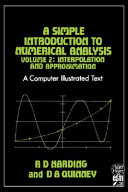
We scan quickly over the 4 different volumes. The introduction to numerical analysis covers the solution of nonlinear equations, recurrence relations (somewhat unusual in an introductory text on numerical analysis), linear equations (Gaussian elimination), numerical quadrature and ordinary differential equations, including boundary value problems. The text contains many examples and exercises that one should try out with the software that is provided.
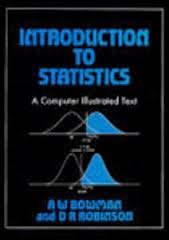
The volume about statistics wants to introduce the reader to the statistical manipulation of data and the tools that statistics provide. We find here a brief introduction to the most important probability distributions and the concept of sampling. We also learn how to fit a probability model (maximum likelihood) and are exposed to concepts like confidence intervals and the techniques of hypothesis testing. For this book, the software is mainly a computer animated illustration of the examples used in the text. There is less room for the user to do his own experiments.
The introduction to signal processing gives mainly qualitative ideas about this discipline. Different kinds of signals (both deterministic and statistical) can be generated with the software. The text covers ideas about their quantitative statistical description in the amplitude- and in the time domain and the problems related to digitalisation (sampling) of the signal, such as quantisation errors, biasing, etc.. This text is accompanied by two disks because one contains simulated signals, to speed up the processing a bit, but still, some of the simulations can take a long time to execute on a simple PC, sometimes to the limit of the patience of the user, especially because there is no way of interrupting an execution that takes too much time for an impatient student.
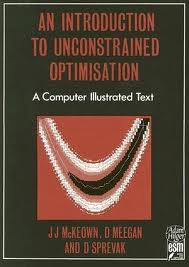
The optimisation text and the software is somewhat better organised than the other ones, maybe because the subject is a bit narrower. The mathematics are better elaborated, the software is flexible and allows the user to experiment freely. The software illustrates the theory very well. The methods are well illustrated by their use of line searches in gradient methods and quasi-Newton methods, as well as the direct search methods. Also here it may require some patience of the user to wait for the colorful contour plots to appear on the screen.
In all cases, the software is easy to install, even for non routine computer freaks. There is an easy, step by step guide to get the software do what you want it to do. Menus are provided which make it very user friendly, but rather narrow in the applications. There is no doubt that the real computer amateur will be a bit disappointed with the power of the software tools and he will probably switch rather quickly to other, more general, software that he can find on the (legal or illegal) market these days.
Reviewer: A. Bultheel (KU Leuven)
January 23, 2013