|
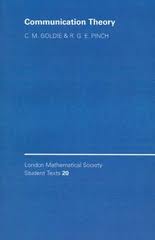
Author(s): Charles M. Goldie, Richard G.E. Pinch
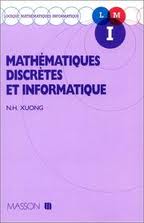
title: Communication theory Series: London Mathematical Society Student Texts, vol 20 Publisher: Cambridge University Press Pages: xiv + 210 Year: 1991 ISBN: 9780521406062 URL: www.cambridge.org/be/knowledge/isbn/item1140529 Author(s): Nguyen Huy Xuong title: Mathématiques discrètes et informatiques Series: Logique, Mathématiques, Informatique Publisher: Masson Pages: xiv + 412 Year: 1992 Short description: Bull. BMS: ♠ MSC main category: 94 MSC category: 94A05 |
|
Review:
These two books are intended as lecture notes. In the case of the first book for students following an introductory course in information theory, in the case of the second book, for undergraduate students in informatics.
The text on communication theory brings together two topics which are usually not found in the same course. The larger part can be characterized as information theory. It takes 4 chapters. The next two chapters are devoted to coding theory. They naturally fit together in this course because they are used to study the reliable transmission of a message over a noisy channel. Traditionally however, these are studied in a separate context, the coding theory being an application of abstract algebra while information theory with notions like entropy, noise, capacity, ... is closer to signal processing and stochastics. The authors have made a perfect marriage of these two components. As lecture notes, the text is well structured with theorems, lemma's, proofs, examples, ... as well as many exercises of varying degree of difficulty. Often hints are provided for their solution. The necessary elements from finite fields and vector spaces are added in an appendix, the necessary elements from Galois theory are derived in the text. A good background in (discrete) probability is however preassumed.
The material which is usually covered by the title of the second book is some set theory, formal logic, Boolean algebra, some elements from graph theory and sometimes discrete probability. Most of these topics are also contained in this volume. Noteworthy are the brief consideration of λ-calculus and elements from universal algebra, but also extensive chapters on counting principles, relational databases, recurrence relations and complexity analysis. There is no discussion discrete probability though. Thus also here we find a somewhat controversial choice of the topics included, but in my opinion an excellent choice is made.
Reviewer: A. Bultheel (KU Leuven)
January 23, 2013