|
Author(s): Ronald L. Graham, Donald E. Knuth, Oren Patashnik
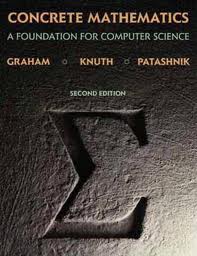
title: Concrete mathematics, a foundation for computer science Publisher: Addison-Wesley Pages: xiii+625 Year: 1989 ISBN: 9780201558029 URL: www.pearson.ch/HigherEducation/Addison-Wesley/1449/9780201558029/ Short description: Bull. BMS: ♠ MSC main category: 68 MSC category: 68-01 Other MSC categories: 00-01, 00A05, 68Rxx |
|
Review:
This book is based on a course given at Stanford University since 1970. When D.E. Knuth wrote his three volumes The art of computer programming, he felt a lack of mathematical skill, needed for the analysis of computer programs. These ``hard'' mathematical techniques, e.g., to compute complicated finite sums, was not offered by the existing ``soft'' mathematics courses, that concentrated on abstract existence theorems for example. So he started the course as an elaboration of the ``Mathematical preliminaries'' section of The art of computer programming.
The major topics of this book are sums, recurrences, elementary number theory, binomial coefficients, generating functions, discrete probability and asymptotic methods. The emphasis is on concrete manipulation techniques. The material may not be confused with what is taught in undergraduate discrete mathematics courses. There are indeed some continuous mathematics too. According to the authors, the qualification concrete was given as a reflection of the blend of continuous and discrete mathematics presented here.
The book contains over 500 exercises ranging from ``warmups'' over ``homework exercises'' to ``research problems''. All solutions, except for the last type, are given in an appendix.
For those who know Knuth's books will not be surprised that this is not a dry mathematics course. Mathematics is fun and the authors try hard to make the reader feel enchanted with the beauty of a mathematical formula. The style of the book is one where you feel that the teacher is there right in front of you. You read sentences like ``Now let's see what we can do with this'', ``Hmm ... doesn't look very pretty'', ``Aha, this sequence looks rather familiar'' etc. Original are also the notes in the margins. Sometimes they are like footnotes of the authors, but most of them are what they call graffiti, contributed by students following the course. For example, when the authors write ``Allright !'' when they are enthusiastic about a formula they have found, the graffiti says ``But your spelling is alwrong''.
The book is dedicated to Leonard Euler. The strive for perfection of the authors goes so far that even the typefaces used in the book for the mathematical formulas is the AMS Euler font, and the computer modern font which was designed by Knuth as the standard font for his TeX typesetting system was adapted to match with this Euler font. Whether you like this font and find it easy to read is probably a matter of taste, but it shows that no effort has been avoided to make the book perfect. The authors promise a reward of USD 2.56 to anyone who finds an error, whether mathematical, historical or typographical. I think it will not be easy to earn this money.
Reviewer: A. Bultheel (KU Leuven)
January 23, 2013