|
Author(s): Søren Brunak, Benny Lautrup
title: Neural networks, computers with intuition Publisher: World Scientific Pages: 180 Year: 1990 ISBN: 978-9971-5-0938-5 URL: www.worldscientific.com/worldscibooks/10.1142/0878 Short description: Bull. BMS: ♠ MSC main category: 62 MSC category: 62M45 |
|
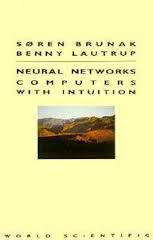
Review:
In their quest to understand the human mind, scientists only recently have tried to simulate with machines the working of a human brain. Such artificial neural networks are oversimplified models of a small part of the neural networks with which nature has equipped living beings. Such networks have a structure that is radically different from classical computers. Within their limitations such artificial brains turn out to be much better in the solution of problems with a cognitive character. The search for an answer to the question how computation is related to intelligence, surfaces thoughts about language, symbolism, cognition, intuition, association, reality etc. on an almost philosophical basis. Questions that have been the playground for theologians and philosophers have now become a research subject for engineers, physicists and biologists.
In this essay, the authors start from the biological brain and gradually move towards computers simulating it. They have written their text for a broad readership where no advanced technical knowledge whatsoever is assumed. While reading it, one has many reminiscences of the masterpiece Gödel, Escher and Bach by D. Hofstadter. The book displays the high competence of the authors on this subject and, somewhat unexpectedly, their sense of humor. The matter discussed is not boring at all, but in a book discussing deep and serious questions, but time and again, the authors manage to give a somewhat unexpected twist to their sentences that will make it difficult to suppress a smile. The English (I assume it is from the authors, since there is no translator mentioned) is very fluent and it is a pleasure to read it, almost like a novel. The authors also keep the attention of the reader awake by taking controversial points of view on some material. To give one example, they argue that dream analysis is nonsense because dreams constitute the garbage of our brain. The knowledge we remember is the result of throwing away the useless information. The latter is the contents of our dreams and one should therefore not attach any meaning to them.
I can recommend this book to all who enjoyed reading D. Hofstadter's book. Even if you are not directly interested in neural networks, there is a fair chance that you will enjoy reading this book.
Reviewer: A. Bultheel (KU Leuven)
January 23, 2013