|
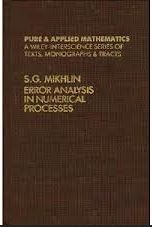
Author(s): Solomon G. Mikhlin
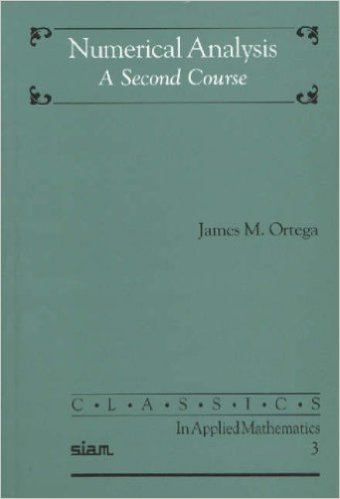
title: Error analysis in numerical processes Series: Pure and Applied Mathematics, vol 283 Publisher: John Wiley & Sons Pages: 283 Year: 1991 ISBN: 978-0471921332 Author(s): James R. Ortega title: Numerical Analysis. A second course Series: Classics in Applied Mathematics, vol 3 Publisher: SIAM Pages: xiii+201 Year: 1990 ISBN: 9781611971323 URL: epubs.siam.org/doi/book/10.1137/1.9781611971323 Short description: Bull. BMS: ♠ MSC main category: 65 MSC category: 65G99 |
|
Review:
The original version of the first book Fehler in numerischen Prozessen was published by Akademie Verlag, Berlin in 1985. This English translation is a considerable extension of the original.
Error analysis is an essential topic in numerical analysis. It has even stimulated in some sense the development of numerical analysis, its concepts, methods and results. Wilkinson's Rounding errors in algebraic processes (Prentice Hall, 1963) is one of the classics that influenced a great deal of the books on numerical analysis that appeared since then.
Mikhlin considers four sources of error (1) the approximation error because the problem is approximated by an easier one, (2) the perturbation error which arises from not calculating the data of the approximating problem exactly, (3) the algorithmic error which occurs because often an algorithm will only give the exact solution after an infinite number of steps, which of course can not be realized and (4) the rounding errors which are a consequence of the (elementary) steps not being performed exactly. In a more classical approach one would take errors of type (1) and (3) together and call it the truncation error, i.e. the error of the numerical method.
The subdivision into four types of errors is kept in the analysis of this monograph. The book contains five parts. The first one collects mostly well known facts on errors in computational arithmetic. The second part discusses extensively the four types of errors for linear numerical processes. Advanced methods like the Ritz method, the Bubnov-Galerkin and collocation method and more generally so called free and recurrent numerical methods are discussed in detail. Part three compiles the results of the author about the stability of methods in linear algebra like direct and iterative processes mainly in linear systems. Part four deals with linear processes, which is basically the error in finite element methods and various methods for solving integral equations (Fredholm and singular ones). The last part tackles nonlinear numerical processes. This includes the Ritz finite element and Newton-Kantorovich methods. Also the perturbation and approximation errors of unilateral variational problems, including some applications to plasticity theory, can be found here.
This monograph can be seen as a successor of Wilkinson's classic that we mentioned in the beginning but at a much more advanced level. This is not the book I would recommend to start with if one wants to learn about numerical error analysis. Most modern introductions to numerical analysis contain a part which gives the basic ideas. For the specialist however this book contains an overwhelming lot of material that can be found in no other book that I know.
The second book by Ortega is a reprint. Like several other publishers, also SIAM has set up this series Classics in Applied Mathematics to reissue textbooks and research monographs that were once declared out of print. The current monograph was originally published by Academic Press in 1972. Some minor corrections are implemented.
Also Ortega discusses error analysis of numerical methods. He distinguishes between three types of errors (1) the discretization error which corresponds more or less to the approximation error of Mikhlin, (2) the rounding error as in the previous monograph and (3) the convergence error which is the same as Mikhlin's algorithmic error. The sensitivity of the solution in terms of perturbation of the data regardless the previously mentioned errors introduced by the numerical method is usually termed condition of the problem.
The question of ill conditioning of certain problems is treated separately in the first part more specifically for systems of linear algebraic equations, for eigenvalue problems and for differential and difference equations. The discretization error (for differential equations) is discussed in the second part.
Part three shows how to treat convergence errors, which is here limited to the problem of convergence of sequences generated by iterative processes for the solution of both linear and nonlinear equations.
The last part studies the rounding errors in Gaussian elimination.
As the title discloses, this is a book suited to use as lecture notes. It contains some exercises and the material is much easier to digest.
It is remarkable that the numerical examples in both of these books are very rare. Certainly in a numerical analysis course, like the second book, the student should be stimulated more to do numerical experiments
For the second book we mention some beauty spots in the typesetting. When a certain scheme is intended to show a symmetry or reveal a certain flow of the computation, it should be carefully done to serve this purpose, if not, it can only add to the confusion. This should be improved in a next printing.
Reviewer: A. Bultheel (KU Leuven)
January 23, 2013